
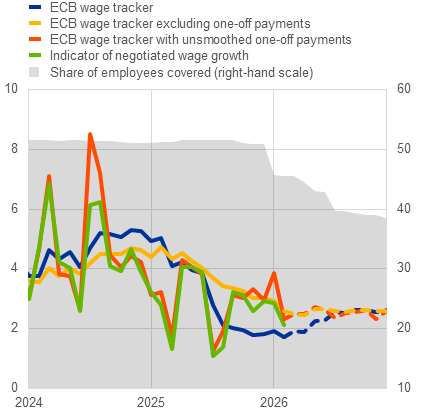
The European Central Bank (ECB) has released its latest wage tracker data, indicating that negotiated wage growth in the euro area is expected to remain stable through 2026. According to the ECB’s wage tracker, which monitors active collective bargaining agreements across nine eurozone countries, wage pressures are projected to hold steady at around 2.6% by the end of 2026. This figure reflects a slight easing compared to recent years but suggests moderate and stable wage growth moving forward.
The ECB’s wage tracker includes several indicators, such as smoothed and unsmoothed one-off payments related to bonuses or inflation compensation. For 2025, negotiated wages with smoothed one-off payments are estimated to grow by 3.2%, while for 2026, the growth rate is expected to moderate to 2.3%. When excluding one-off payments, the growth rate is predicted to ease from 3.8% in 2025 to 2.6% in 2026. The data also show that wage growth will gradually increase over the course of 2026, from around 1.8% in the first quarter to 2.6% by the last two quarters.
This steady outlook comes amid a complex economic environment marked by geopolitical tensions and fluctuating energy prices. The recent ceasefire in the Iran conflict has eased immediate inflationary pressures, particularly those linked to oil prices, which had previously surged close to $120 per barrel before dropping back below $90 in April. Despite this relief, uncertainties remain about how quickly oil production and supply routes will stabilize, keeping inflation risks on the ECB’s radar.
Market expectations have shifted accordingly. While the ECB held interest rates steady at 2% during its April meeting, analysts anticipate possible rate hikes later in the year, likely beginning in June. The central bank aims to manage inflation expectations carefully without stifling economic growth, which has shown signs of weakening due to higher energy costs and slowing business activity across key eurozone economies such as Germany and France.
The ECB’s cautious stance reflects concerns over second-round inflation effects, such as rising wages feeding into broader price increases. However, recent surveys indicate that firms expect wage growth to moderate rather than accelerate in the near term, suggesting that wage-price spirals may remain contained for now.
Overall, the ECB’s wage tracker provides valuable insight into negotiated wages across major eurozone countries including Germany, France, Italy, Spain, and others, covering roughly half of employees in these nations. The data is subject to revision as new collective agreements are signed but currently point towards a balanced scenario where wage growth supports consumer spending without exacerbating inflationary pressures excessively.
As policymakers prepare for future decisions, they must weigh the evolving economic signals carefully. The possibility of two interest rate increases later this year is seen as a measure to prevent inflation from becoming entrenched while allowing for economic recovery amid lingering uncertainties surrounding energy markets and geopolitical developments.