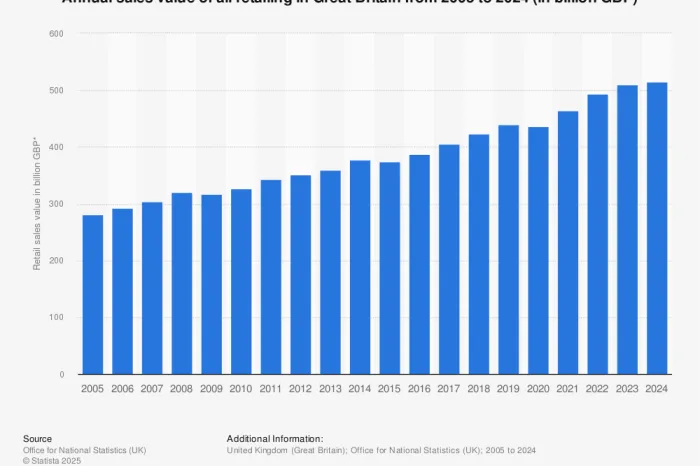
The British pound has come under pressure recently as disappointing UK retail sales data raised concerns about the country’s economic outlook. In April, UK retail sales fell by 1.3% month-over-month, significantly worse than the forecasted 0.6% decline, according to figures from the Office for National Statistics. Core retail sales, excluding automotive fuel, also dropped by 0.4%, surpassing expectations of a 0.3% fall. On a yearly basis, retail sales showed no growth in April, a sharp slowdown from the previous revised increase of 1.4%, signaling a clear weakening in consumer spending momentum.
This decline in retail activity highlights the ongoing challenges faced by UK households amid high inflation, rising energy costs, and elevated interest rates. Despite some resilience in wage growth, the cost-of-living pressures are eroding real purchasing power and dampening consumer sentiment. As consumer spending is a critical driver of the UK economy, the weak data raises concerns about potential further slowdowns in economic growth.
The Bank of England is now navigating a complex policy environment. While inflationary pressures remain due to wage increases and energy prices, slowing consumption and economic activity may limit the central bank’s ability to continue aggressive interest rate hikes. Market participants have noted diverging views among Bank of England officials regarding future monetary policy, reflecting uncertainty about balancing inflation control with supporting economic growth.
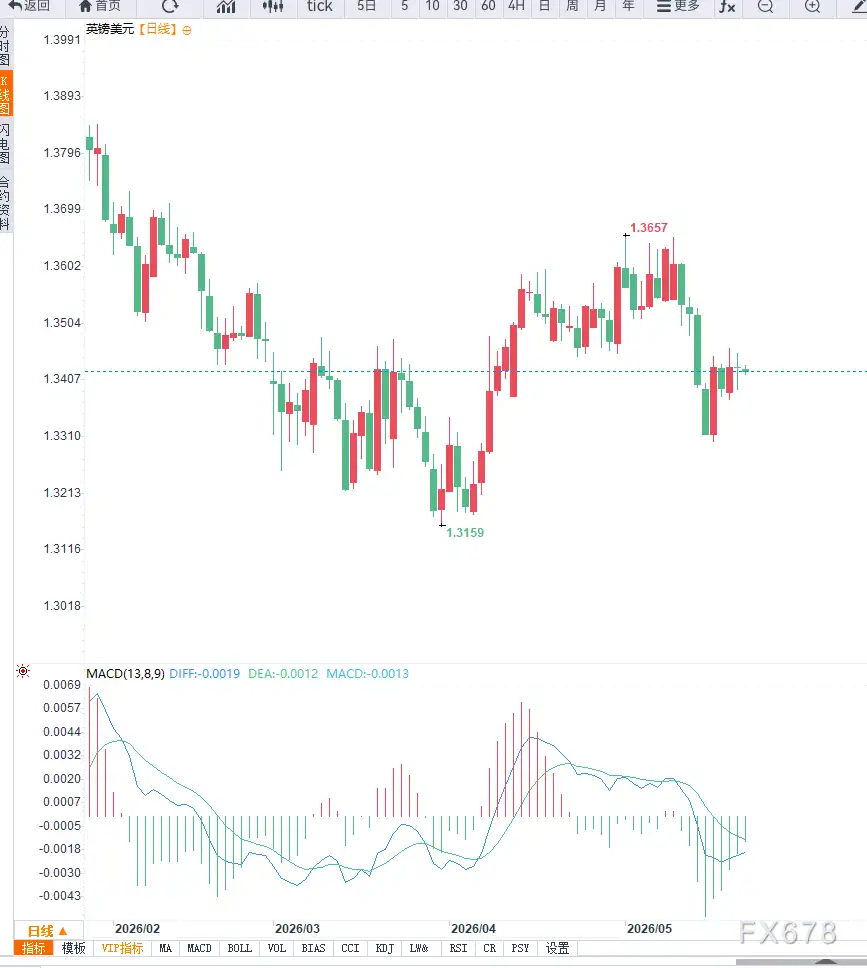
Meanwhile, the US dollar has maintained strength supported by expectations of continued Federal Reserve rate hikes amid resilient US economic data and higher energy prices. Federal Reserve Governor Christopher Waller’s recent comments signaled openness to future rate increases, adding to the dollar’s appeal among investors seeking safe-haven assets. This external factor has compounded pressure on GBP/USD, which has struggled to break above resistance levels near 1.3450–1.3480.
Technical indicators suggest GBP/USD is entering a consolidation phase with weakened upward momentum. The daily MACD is flattening at elevated levels while the RSI has moved from overbought territory toward neutral levels around 55. Short-term support lies near 1.3380, with potential further declines toward 1.3320 and 1.3260 if bearish sentiment continues. On the upside, key resistance remains at 1.3450 and the psychological level of 1.3500.
Adding to market uncertainty are geopolitical developments such as tensions in the Middle East and ongoing discussions around a possible US-Iran deal, which could influence currency movements if resolved positively. Analysts also caution that despite recent US dollar gains, these may be temporary rather than indicative of a long-term structural shift, as factors like safe-haven demand soften and global investors diversify their exposure.
In summary, GBP/USD currently faces a dual challenge: domestic economic weakness in the UK combined with sustained US dollar strength. Market participants will closely monitor upcoming UK economic data releases and central bank communications for clues on future direction. Should UK consumer spending remain subdued while US monetary policy stays hawkish, further downside pressure on GBP/USD appears likely in the near term.