Japan’s Ministry of Finance confirmed a substantial foreign exchange intervention by the Bank of Japan (BoJ) between April 28 and May 27, marking the largest quarterly action since 2004. The BoJ reportedly spent approximately JPY11.735 trillion to influence the USD/JPY exchange rate, initiating efforts around April 30 that successfully pushed the rate from above 160 down to below 156. This intervention was sustained over several trading days, reflecting the significant scale and urgency of the move.
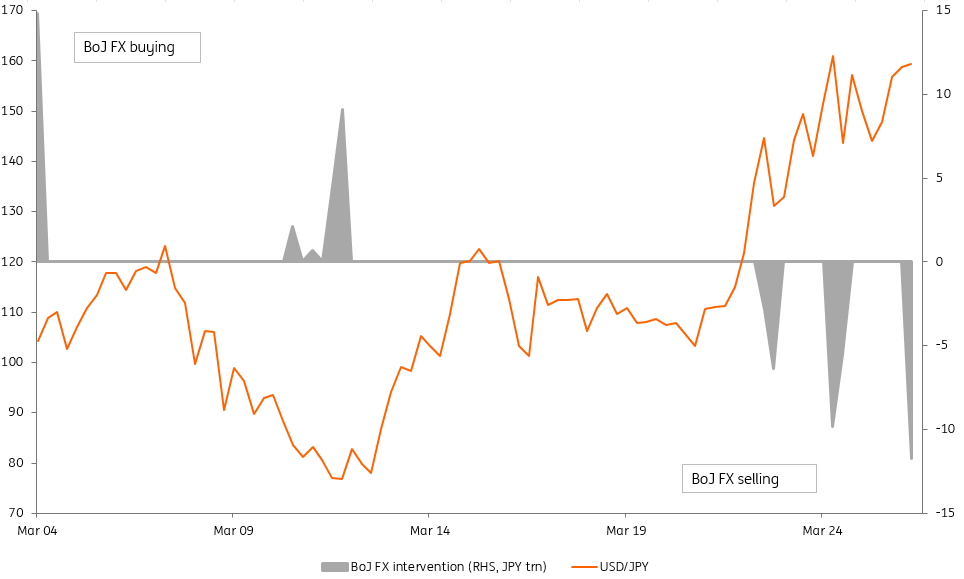
The last comparable intervention occurred in early 2004 when the BoJ frequently intervened to prevent the USD/JPY from falling below 100 during a period of a weakening dollar and very low U.S. interest rates following the dot-com crash. Since then, Japanese interventions have been far less frequent and more modest in size, partly due to concerns about how such actions might affect Japan’s classification under the International Monetary Fund’s foreign exchange regime system.
Despite this large-scale effort, the USD/JPY rate has since climbed back close to 160, raising questions about the effectiveness of the intervention. Unlike in 2024, when market conditions favored a weaker dollar and the Federal Reserve was preparing to ease rates, current market sentiment is less bearish on the yen and increasingly anticipates further Fed rate hikes rather than cuts. This dynamic makes it difficult for Japan to gain lasting control over the currency’s value.
The intervention also has implications beyond foreign exchange markets. To finance these operations, Japanese authorities appear to have reduced their holdings of U.S. Treasuries by around $100 billion in 2024, consistent with previous years’ patterns. However, these sales are limited by Japan’s sizeable foreign exchange reserves, which exceed $1 trillion. Officials are unlikely to allow reserve depletion beyond 20-30%, placing natural constraints on how frequently and extensively interventions can be conducted.
Looking ahead, market analysts expect that the BoJ may need to intervene again if USD/JPY moves above the 160 level once more. A potential rate hike by the BoJ is anticipated around June 16, with a probability of about 78%. However, for such a hike to meaningfully alter currency dynamics, it would have to be notably hawkish—raising policy rates above current levels and shifting real interest rate differentials in favor of the yen. Given Japan’s current political climate, such a move could prove challenging.
Until any significant policy shifts occur, forecasts suggest that USD/JPY will remain elevated near 160 or even test levels around 162-163 in the short term. A decline toward 155 by year-end hinges largely on softer U.S. economic activity and a potential Fed pivot toward rate cuts later this year—a scenario increasingly viewed as uncertain amid persistent inflationary pressures.
In summary, Japan’s recent intervention represents its most aggressive attempt in over two decades to stabilize its currency amid complex global financial conditions. Yet, without stronger domestic monetary tightening or a change in U.S. interest rate expectations, managing USD/JPY remains an uphill battle for Japanese policymakers.