
Gold has become the largest global reserve asset for central banks, overtaking U.S. Treasuries by the end of 2025, according to a recent report from the European Central Bank (ECB). The share of gold in total official foreign reserves rose to 27%, up from 20% the previous year, while U.S. Treasuries declined to 22% from 25%. Euro-denominated reserves remained steady at around 15%. This shift reflects ongoing efforts by many countries to diversify their reserves away from the U.S. dollar amid geopolitical tensions and economic uncertainty.
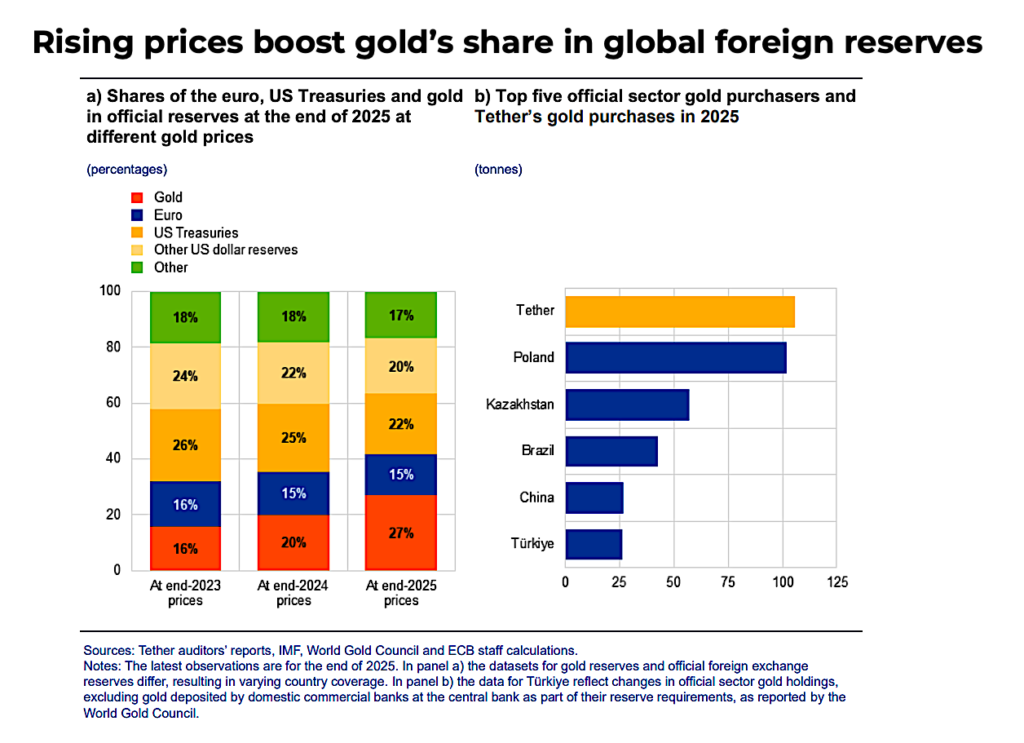
The ECB report highlights that central banks continue to increase their gold holdings despite a slowdown in purchases during 2025. The rise in gold’s share is largely due to its sharp price increase, which surged approximately 60% in 2025 and 30% in 2024. Although physical gold purchases dropped slightly to about 850 tonnes last year from over 1,000 tonnes annually in previous years, the value gains have made gold a more significant part of reserve portfolios.
Geopolitical risks remain a major driver behind central banks’ preference for gold. Countries facing external conflicts or economic pressures—such as China, Poland, Turkey, and India—have been among the largest buyers. Since Russia’s invasion of Ukraine in 2022 and subsequent freezing of Russian dollar reserves by Western nations, many countries have sought to reduce dependence on dollar-denominated assets. Despite this trend, dollar assets still account for the largest share of global reserves at 42%, underscoring the dollar’s continued dominance.
The ECB also pointed out some limitations of gold as a reserve asset. Unlike major fiat currencies, gold does not earn interest or dividends and can be costly to store when held physically. Its price can be volatile, and supply is relatively fixed, making it less flexible compared to currency reserves when meeting international liquidity demands. Nevertheless, central banks view gold as an important tool for diversification and a hedge against geopolitical and financial risks.
Interestingly, stablecoin issuer Tether was noted as one of the largest single buyers of gold in 2025, acquiring over 100 tonnes. Meanwhile, Turkey reduced its gold reserves by selling or loaning about 130 tonnes early in 2026 after increasing its holdings significantly since 2022.
The ECB report also highlighted the euro’s growing role in international finance. International debt issuance denominated in euros rose by nearly 30% last year to close to €1 trillion ($1.2 trillion). Foreign investors increased their holdings of euro-area assets substantially, pushing portfolio inflows near record highs. The euro also performed like a safe-haven currency during several periods of market stress in late 2025 and early 2026.
This milestone for gold marks a significant shift in global reserve management and carries important implications for the international monetary system. Central banks are increasingly diversifying their portfolios amid geopolitical uncertainties and shifting economic alliances. While gold’s rise challenges U.S. Treasuries’ long-held position as the top reserve asset, the overall landscape remains complex with multiple factors influencing future trends.