The Federal Reserve’s monetary policy continues to have a significant impact on the US economy and financial markets, with particular effects on regional banks and ongoing discussions about the Fed’s balance sheet management. Recent developments highlight how political pressure on the Fed and its policy decisions are influencing banking sectors, loan growth, and investor confidence.
Several regional banks are closely watched as they stand at the intersection of these monetary policy shifts. For example, USCB Financial Holdings, based in Miami, operates primarily in South Florida and the Caribbean, focusing on commercial and consumer banking. The bank is navigating a complex environment shaped by fluctuating interest rates and potential changes within the Federal Reserve’s regional leadership. While some analysts see value in USCB’s current stock price compared to earnings expectations, concerns remain over its exposure to commercial real estate and recent insider selling.
Similarly, Bank of Marin Bancorp in Northern California is structured to endure various interest rate scenarios while pursuing growth through expansion and digital upgrades. Its conservative approach to underwriting and capital management has helped maintain stability despite challenges such as rising regulatory costs and credit charge-offs. However, investors should be cautious as the bank faces pressure from local commercial real estate concentrations and dividend coverage issues.
Peapack-Gladstone Financial, serving the New York and New Jersey metro areas, blends traditional banking with wealth management services that generate fee income less sensitive to interest rate changes. Despite improvements in net interest margins and operational efficiency, the bank contends with a higher price-to-earnings ratio than many peers and signs of insider selling. Political developments affecting Federal Reserve policy add uncertainty for its future performance.
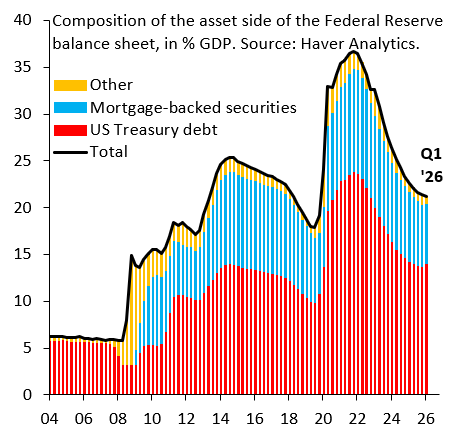
Beyond individual banks, a broader debate surrounds the Fed’s ability to reduce its balance sheet significantly. Since the 2008 financial crisis, the Fed expanded its holdings of Treasury securities and mortgage-backed assets to support economic recovery when traditional interest rate cuts were no longer sufficient. This expansion helped lower long-term borrowing costs but created challenges for future monetary policy normalization.
Efforts to shrink the balance sheet through quantitative tightening (QT) have been limited and short-lived compared to earlier asset purchases (quantitative easing). Market tolerance for rising yields and increased volatility remains low, making large-scale reduction unlikely. Moreover, recurring economic shocks often prompt renewed Fed intervention to stabilize financial conditions, further increasing the balance sheet over time.
While regulatory tools like financial repression can encourage banks to hold more government debt to ease balance sheet reduction pressures, these measures have limited capacity to offset the overall trend. Analysts suggest that meaningful shrinkage of the Fed’s holdings would be beneficial by allowing market forces greater influence over yields and encouraging fiscal discipline. However, political realities make such moves improbable in the near term.
In summary, Federal Reserve policies continue to exert strong influence on regional banking sectors and broader market dynamics. Banks positioned in key Fed districts face unique challenges and opportunities shaped by shifting interest rates, regulatory environments, and political developments. Meanwhile, debates about the Fed’s balance sheet strategy highlight ongoing tensions between economic stability goals and long-term financial market health.