
The Bank of Japan (BOJ) has taken notable steps to address the weakening of the Japanese yen, but its efforts face ongoing challenges amid complex economic conditions. On July 2, 2026, the yen approached a historic low near 163 against the US dollar, levels unseen in four decades. In response, the BOJ made a surprise market intervention that temporarily strengthened the yen by about 1%, reversing some of the currency’s recent depreciation. This intervention was executed quietly alongside the release of US employment data, signaling a shift away from prior practices of pre-announcing such moves.
Despite this tactical change aimed at catching short-sellers off guard, experts remain skeptical about the long-term impact. The fundamental economic factors driving yen weakness persist. Inflation in Japan remains elevated by local standards, and the manufacturing and services sectors show modest expansion. However, a significant interest rate gap between Japan and the United States continues to fuel carry trade strategies where investors borrow cheap yen to invest in higher-yielding dollar assets. Until this gap narrows, downward pressure on the yen is expected to continue.
Alongside direct market interventions, the BOJ has also embarked on a substantial quantitative tightening (QT) campaign since late 2024. The central bank has reduced its massive balance sheet by selling government bonds and equity holdings at an accelerated pace. By the end of June 2026, total assets on its balance sheet shrank by approximately 15.6% from their peak in early 2024, marking one of the most aggressive QT efforts among major central banks. This approach aims to support the yen by allowing long-term interest rates in Japan to rise, with 30-year government bond yields reaching around 4%.
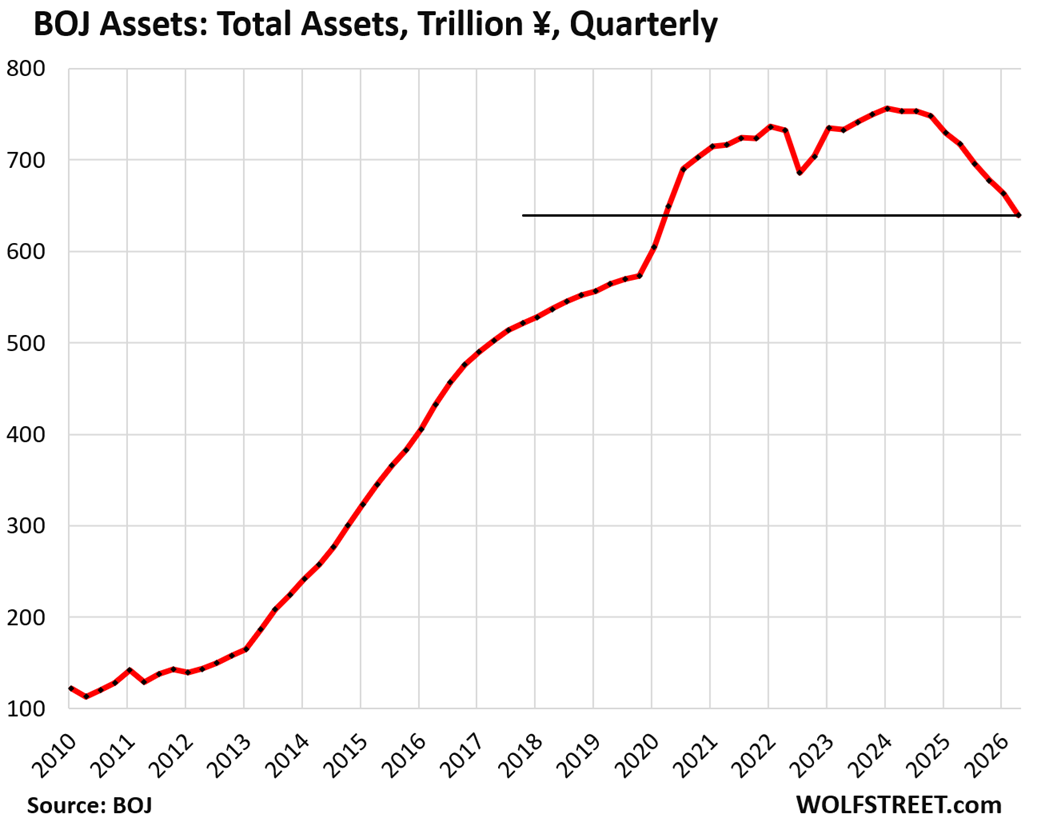
However, policy rates have only seen modest increases, with the BOJ raising its short-term interest rate to just 1%, a level still considered low compared to other economies. This cautious stance reflects concerns about maintaining economic growth while managing inflation and currency stability. A government economic panel member recently called for moderate but steady rate hikes—suggesting two additional increases spaced six months apart—to help correct excessive yen depreciation. This view aligns with Prime Minister Sanae Takaichi’s administration focus on balancing monetary tightening with supportive fiscal measures aimed at boosting Japan’s supply capacity and overall economic resilience.
Market reactions to these developments have been mixed. Technical analysis indicates that despite recent interventions, the USD/JPY exchange rate may continue its upward trajectory toward previous highs near 163 yen unless further BOJ actions occur. The threat of surprise interventions has increased uncertainty among forex traders, leading to higher demand for options protecting against sudden currency swings.
Looking ahead, Japan’s monetary authorities appear poised to continue their delicate balancing act—using a combination of surprise interventions, gradual rate hikes, and quantitative tightening—to stabilize the yen without undermining economic growth. The effectiveness of these policies will be closely watched by global markets as they navigate ongoing inflation pressures and evolving geopolitical risks.