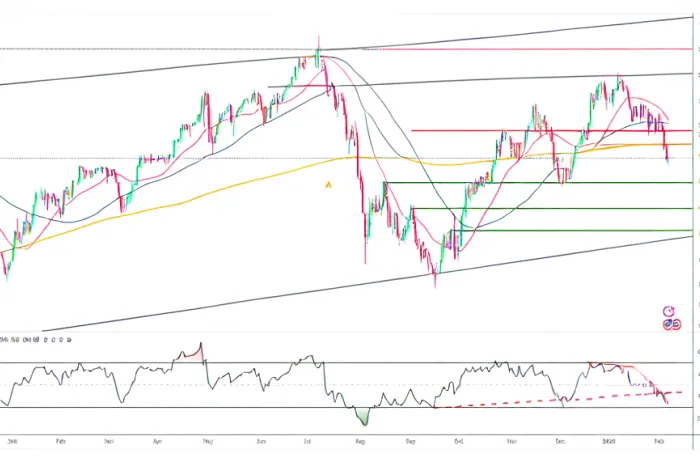
The USD/JPY currency pair has recently experienced significant volatility following aggressive intervention by Japan’s Ministry of Finance (MoF). On April 30 and May 1, 2026, the MoF stepped in after the pair breached the critical 160.00 level, executing large-scale yen-buying operations estimated to exceed $30 billion. This intervention caused the yen to rally sharply by about 2.2%, pushing the exchange rate down to the 156.00 range. While this move temporarily curbed the dollar’s advance against the yen, market analysts warn that such unilateral interventions may only delay further shifts rather than reversing the long-term trend without fundamental economic changes.
Looking at recent market behavior, USD/JPY has shifted from a steady upward trend to a period marked by heightened volatility and sideways trading. The daily charts show a strong rejection at the 160.00 psychological threshold, with the pair falling below key moving averages such as the 50-day and 100-day moving averages. Technical indicators like the Relative Strength Index (RSI) have retreated from overbought conditions, signaling a pause in the recent parabolic rise. However, despite this correction, the long-term bullish trend remains intact as long as USD/JPY holds above major support levels near 154.50 and the 200-day moving average.
Shorter-term charts reveal a consolidation phase between resistance at approximately 157.89–158.00 and support near 156.27. The four-hour chart highlights volatile swings with recent bullish divergence signals suggesting some recovery attempts, though these rallies are met with selling pressure. Intraday trading shows a tug-of-war dynamic, with price action struggling to surpass the 158.00 mark while maintaining support around 156.27. Traders are advised to watch these critical levels closely as a break below support could open the door for further declines toward psychological levels near 155.00.
Market experts also point to persistent intervention risk as a key factor influencing USD/JPY’s outlook. OCBC analysts emphasize that Japan’s central bank maintains an ultra-loose monetary policy in stark contrast to the Federal Reserve’s hawkish stance, sustaining wide interest rate differentials that favor dollar strength. However, repeated interventions by Japanese authorities create a ceiling on USD/JPY gains and increase uncertainty for traders. Historical examples show that while interventions can cause sharp short-term moves, their impact often fades without accompanying shifts in economic fundamentals or coordinated international support.
Adding complexity is the broader economic backdrop, including ongoing geopolitical tensions such as the US-Iran conflict impacting energy prices and Japan’s economy facing inflationary pressures alongside sluggish wage growth. These factors challenge BoJ policymakers who must balance inflation control with supporting economic growth, complicating any potential policy normalization that could influence currency trends.
Given this environment, many analysts expect USD/JPY to trade within a defined range for the near term, with intervention risk serving as a persistent wildcard. Traders are encouraged to adopt cautious strategies focusing on key technical levels and employing risk management tools like stop-loss orders and options hedges. While opportunities exist in both range-bound trading and potential breakout scenarios, market participants should remain vigilant for sudden shifts triggered by policy announcements or unexpected economic data.
In summary, USD/JPY is navigating a turbulent period shaped by aggressive BoJ intervention efforts, diverging central bank policies, and uncertain global economic conditions. Although immediate volatility may continue, longer-term trends depend heavily on fundamental developments and whether Japan’s monetary authorities adjust their stance amid evolving domestic and international pressures.