The EUR/USD currency pair is currently experiencing a period of range-bound trading as investors await clear market catalysts. Both the Federal Reserve (Fed) and the European Central Bank (ECB) recently held their key interest rates steady, creating a policy convergence that has led to limited directional movement in the euro-dollar exchange rate. With the pair trading near 1.1571, it remains confined within an eleven-week consolidation range between approximately 1.15 and 1.18.
This stable environment reflects a 150 basis point differential between U.S. and Eurozone interest rates, which is largely priced into the market. The Fed’s federal funds rate remains at 3.50-3.75%, while the ECB has maintained its deposit facility rate at 2.00%, though it raised its inflation forecast due to uncertainties linked to the ongoing conflict in the Middle East. These policy decisions have removed major monetary policy surprises, resulting in subdued volatility and neutral technical indicators such as RSI and moving averages.
Market participants are closely watching several key levels that could signal a breakout from this range. Resistance levels near 1.1650 and 1.1750 represent critical barriers, with support seen around 1.1426 and 1.1350. Traders note that sustained moves above or below these levels on a closing basis would likely trigger new trends, particularly if driven by geopolitical developments or economic data releases.
The Middle East conflict remains a significant factor influencing EUR/USD dynamics. Tensions around the Strait of Hormuz have impacted global energy prices, pushing oil above $100 per barrel at times and causing concerns about energy supply disruptions to Europe. This has elevated inflation pressures in the Eurozone and increased stagflation risks, complicating the ECB’s policy outlook.
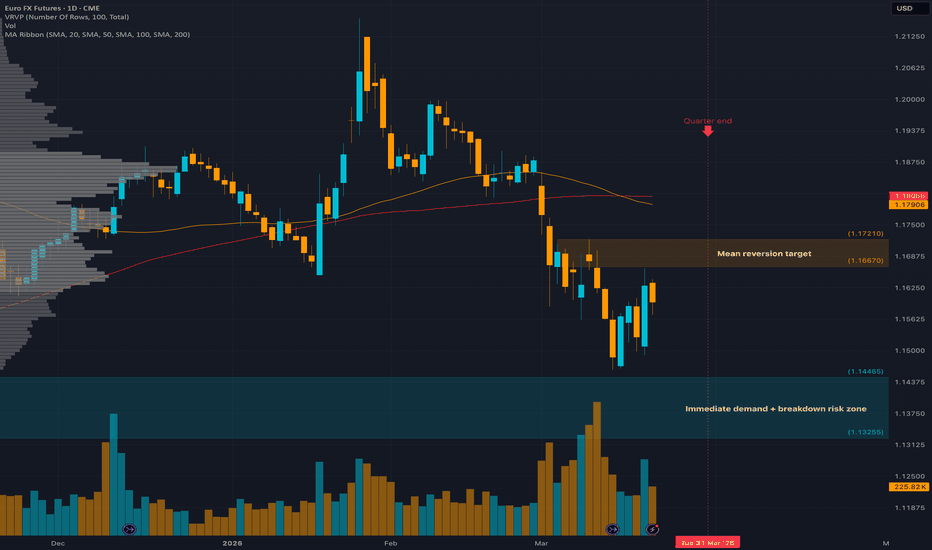
Technical analysis points to potential short-term trading opportunities within this range. Some traders are positioning for short entries near resistance zones around 1.1750, anticipating pullbacks due to overbought conditions and liquidity exhaustion among buyers. Conversely, long positions are considered around lower support areas near 1.1650 where volume imbalances and technical indicators suggest possible rebounds.
In addition to geopolitical risks, upcoming economic data such as Eurozone GDP figures, U.S. inflation reports, and central bank meetings scheduled later this month are expected to provide fresh directional cues for EUR/USD traders. Portfolio rebalancing flows ahead of quarter-end may also induce mechanical demand shifts for euros, potentially pushing prices higher within the existing range.
The evolving market structure also highlights a growing role for FX futures trading in EUR/USD exposure management. Futures markets offer advantages such as lower transaction costs, greater transparency, and centralized price discovery compared to over-the-counter contracts for difference (CFDs). This shift has been supported by recent industry reports showing increased institutional adoption of listed FX instruments.
Overall, the EUR/USD remains caught between stable monetary policies and external uncertainties, with no clear directional bias until new catalysts emerge. Traders are advised to maintain disciplined risk management strategies and monitor key technical levels alongside fundamental developments to navigate the current environment effectively.