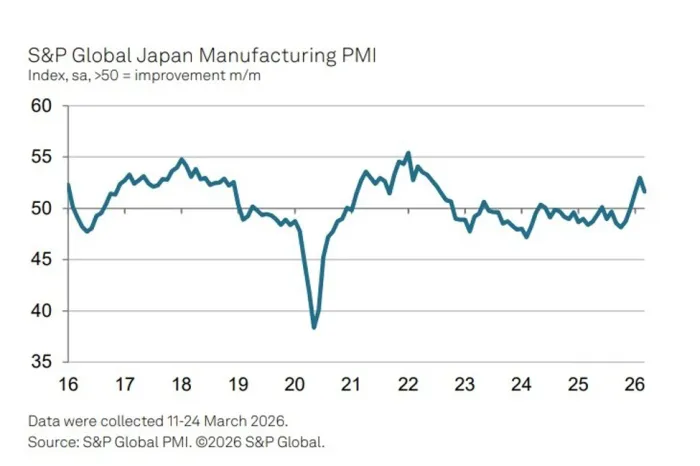
Japan’s industrial sector experienced significant growth in April 2026, with the S&P Global Japan Manufacturing Purchasing Managers’ Index (PMI) reaching 55.1. This figure represents the strongest expansion since January 2022 and surpasses both the preliminary estimate of 54.9 and March’s reading of 51.6. The sharp rise highlights robust manufacturing activity driven by increased production and a surge in new orders. Companies have also been ramping up inventories, reflecting concerns about potential supply chain disruptions linked to geopolitical tensions in the Middle East.
Despite this encouraging industrial performance, inflationary pressures in Tokyo remained subdued. The core consumer price index (CPI) rose by just 1.5% year-on-year in April, down from 1.7% in March and falling short of economists’ expectations of 1.8%. This marks the third consecutive month that inflation has failed to reach the Bank of Japan’s (BOJ) 2% target, signaling ongoing difficulties in achieving sustained price increases.
Financial markets showed mixed reactions to these developments. The Nikkei 225 edged up 0.4%, breaking above the 59,500 level, while the broader Topix index declined 0.5% to approximately 3,708 points amid uneven trading volumes. The Japanese yen also experienced fluctuations against the US dollar, settling near 157 yen per dollar after briefly strengthening by around 3% to near 155.5 yen following verbal interventions aimed at stabilizing the currency.
These contrasting economic signals underscore Japan’s complex environment as it faces external challenges such as rising energy costs and geopolitical uncertainty while striving to foster steady inflation growth. Retail sales demonstrated resilience with a 1.7% increase, supported by government stimulus measures, although some intermittent obstacles persisted within industrial output.
The Bank of Japan remains cautious as it evaluates these indicators, balancing its monetary policy stance against inflation targets. The divergence between strong manufacturing growth and muted inflation presents a challenging scenario for policymakers seeking to maintain economic momentum without provoking excessive market volatility.
In summary, Japan’s economy exhibits a combination of strength and caution: manufacturing activity is gaining traction thanks to strategic stockpiling and recovering demand, yet inflation remains below BOJ’s desired threshold. This dynamic complicates efforts to establish long-term price stability amid ongoing global uncertainties.