
The euro area recorded a current account surplus of €15 billion in March 2026, marking a significant decrease from the €26 billion surplus reported in February. This decline was driven by lower surpluses in goods, services, and primary income, alongside a growing deficit in secondary income. Over the 12 months leading up to March 2026, the current account surplus totaled €275 billion, equivalent to 1.7% of the euro area’s GDP, down from €368 billion or 2.4% the previous year.
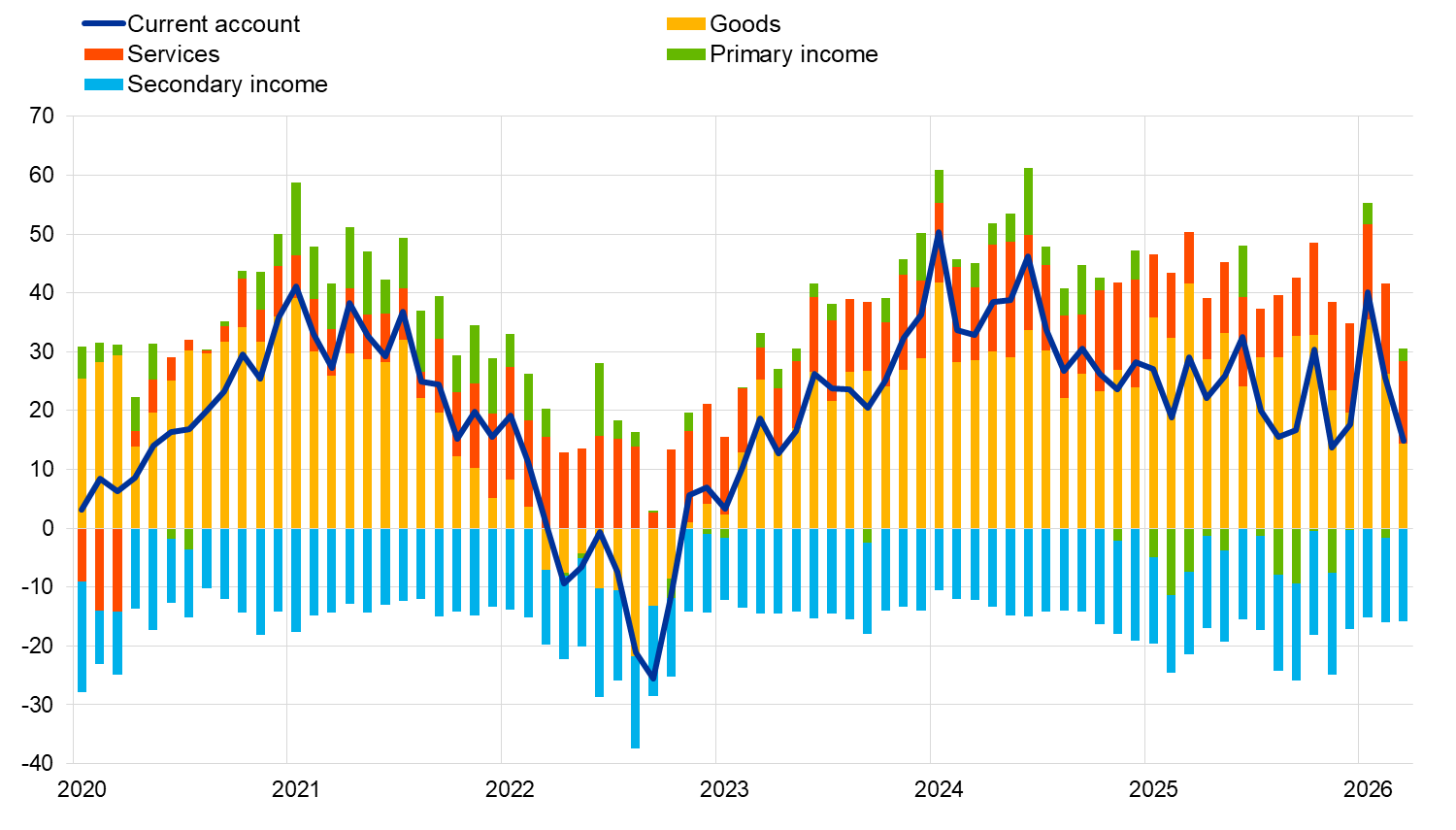
Goods and services remained positive contributors with surpluses of €14 billion each in March. However, the primary income balance shifted from a surplus of €17 billion in the previous year to a deficit of €19 billion in the latest 12-month period. The deficit for secondary income widened from €179 billion to €192 billion, further weighing on the overall current account balance.
In terms of financial flows, euro area residents increased their net investments in non-euro area assets, with direct investments reaching €272 billion over the past year, up from €163 billion a year earlier. Non-residents also showed renewed interest in euro area assets, investing a net amount of €42 billion compared to net disinvestments of €27 billion previously.
Portfolio investments revealed mixed trends: euro area residents’ net purchases of non-euro area equity decreased to €196 billion from €234 billion, while net purchases of non-euro area debt securities slightly declined to €583 billion. Conversely, non-residents’ net purchases of euro area equity dropped to €436 billion from €514 billion, but their net acquisitions of euro area debt securities rose sharply to €545 billion from €357 billion.
Other investment activities saw euro area residents acquiring non-euro area assets worth €595 billion over 12 months, an increase from €508 billion the prior year. Meanwhile, liabilities incurred by residents grew to €361 billion from €218 billion.
The monetary presentation of the balance of payments showed that net external assets of euro area monetary financial institutions (MFIs) increased by €360 billion over the year ending March 2026. This growth was mainly supported by surpluses in current and capital accounts and strong portfolio investment inflows from non-MFIs into equity and debt securities. However, these were partly offset by net outflows in direct investments.
The Eurosystem’s reserve assets declined notably to €1,908.1 billion at the end of March 2026 from €2,045.8 billion in February. This reduction was primarily due to negative price changes amounting to €149.0 billion, largely attributed to falling gold prices. Positive exchange rate movements and small net asset acquisitions partially mitigated this decline.
Overall, these figures highlight a moderation in the euro area’s external surplus and shifts in investment patterns amid changing global economic conditions. The European Central Bank continues to monitor these developments closely as they reflect important aspects of the region’s economic interactions with the rest of the world.