The Australian dollar showed mixed performance against the US dollar following the release of Australia’s latest trade balance data, which revealed a return to surplus in April. Despite the positive trade figures, the AUD/USD pair remained subdued due to ongoing geopolitical tensions in the Middle East that bolstered safe-haven demand for the US dollar.
Australia’s trade balance swung back into a surplus of AUD 1.791 billion in April, reversing the previous month’s deficit of AUD 1.024 billion. This improvement was driven primarily by a 7.2% increase in exports, which recovered from a decline in March, while imports rose only slightly by 0.8%, indicating cooling domestic demand. The robust export performance reflects continued strength in commodity prices and solid demand from key trading partners, supporting the external sector of the Australian economy.
However, despite these encouraging trade numbers, the Australian dollar did not strengthen significantly against the US dollar during early trading sessions. Market participants attributed this muted response to heightened geopolitical uncertainties surrounding stalled peace negotiations in the Middle East. Iranian officials confirmed that talks to end regional conflicts have made “no tangible progress,” which increased safe-haven flows into the US dollar and limited upside momentum for the AUD.
Economic analysts note that while the trade surplus signals resilience in Australia’s external sector, domestic factors such as moderated import growth suggest weaker internal demand, possibly constraining the Reserve Bank of Australia’s (RBA) ability to raise interest rates further. Inflation data released earlier showed a deceleration in headline inflation to 4.2% year-on-year in April, easing pressure on the RBA but keeping inflation above its target range. Additionally, unemployment has risen to its highest level since late 2021, adding complexity to monetary policy decisions.
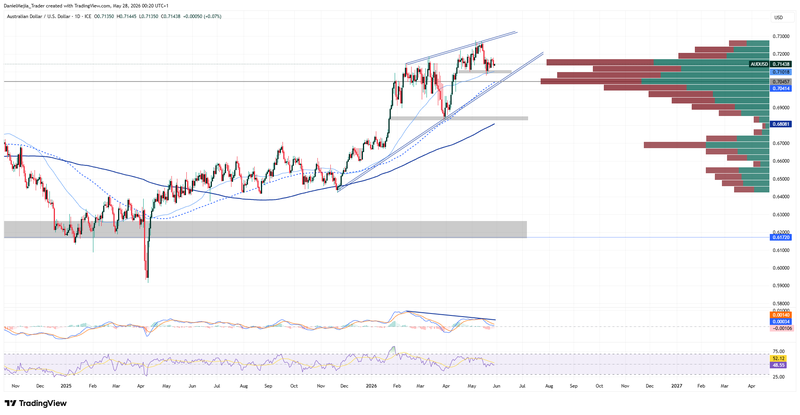
From a technical perspective, the AUD/USD pair remains within a long-term bullish trend despite short-term fluctuations. The currency pair is currently trading around 0.7125, near key moving averages that offer underlying support. Technical indicators suggest a consolidation phase with balanced bullish and bearish momentum as traders await clearer directional signals. Analysts expect AUD/USD to trade within a range near current levels unless significant changes occur in global risk sentiment or economic data releases.
Looking ahead, market focus will turn to upcoming US economic reports, particularly the Nonfarm Payrolls data, which could influence US dollar strength and indirectly impact AUD/USD dynamics. The interplay between Australia’s improving trade position and global geopolitical risks will likely continue shaping investor sentiment towards the Australian dollar in the near term.
Overall, while Australia’s return to a trade surplus provides fundamental support for the AUD, external geopolitical pressures and mixed domestic economic signals create an environment of cautious optimism among traders and policymakers alike.