The EUR/USD currency pair experienced notable fluctuations on June 17, 2026, as markets reacted to a significant shift in U.S. Federal Reserve policy under the new Chairman, Kevin Warsh. The Federal Open Market Committee (FOMC) maintained interest rates within the expected range of 3.50% to 3.75%, but the tone of their statement marked a clear hawkish pivot, removing previous easing signals and indicating the possibility of further rate hikes this year. This change in stance was supported by strong U.S. economic data, including a surprising 0.9% increase in May retail sales and robust core retail sales growth, signaling a resilient consumer sector despite high interest rates.
In contrast, the euro faced pressure due to a lack of positive domestic economic drivers. The Eurozone’s inflation rate held steady at 3.2% year-on-year, in line with expectations but without any hawkish surprises that might encourage the European Central Bank (ECB) to adopt a more aggressive tightening approach. Additionally, subdued industrial production and trade balance figures underscored ongoing economic weakness relative to the U.S. Meanwhile, easing concerns over energy supplies—driven by falling crude oil prices linked to a potential diplomatic agreement opening the Strait of Hormuz—have yet to significantly boost the euro.
Technically, the EUR/USD shows mixed signals. Momentum indicators such as the MACD suggest neutrality, while the Relative Strength Index (RSI) indicates neither oversold nor overbought conditions. Resistance is observed near the 1.1650 and 1.1700 levels, which analysts view as critical barriers for any sustained euro recovery against the dollar. Support levels around 1.1500 and potentially 1.1400 are also closely monitored in case of further downside pressure.
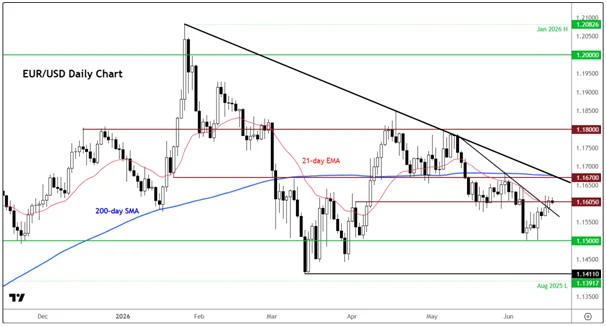
Looking ahead, market watchers are focusing on how Fed Chair Warsh will communicate future monetary policy intentions during upcoming remarks. The market expects that for the dollar to maintain its recent strength, clear signals about additional tightening must be provided. Otherwise, a softer Fed stance could allow the EUR/USD to rally beyond current resistance zones, possibly reaching toward 1.17 or higher.
At the same time, Eurozone stagflation concerns persist amid downgraded growth forecasts between 0.8% and 0.9% for 2026 and ongoing inflation pressures fueled by energy costs and geopolitical risks related to Middle Eastern conflicts affecting vital shipping routes and energy imports. These factors limit the ECB’s ability to match U.S. rate hikes without risking a deeper recession.
Meanwhile, the broader FX market has shown resilience in the U.S. dollar despite recent declines in oil prices following a tentative US-Iran peace agreement aimed at normalizing energy flows through key chokepoints like the Strait of Hormuz. Although this development initially eased risk premiums and supported risk appetite globally, investors remain cautious about geopolitical uncertainties that could still disrupt oil supplies.
Analysts from ING and Credit Agricole predict continued bearish momentum for EUR/USD into the summer months due to economic divergences between the U.S. and Eurozone economies, with some forecasts suggesting potential dips toward one-year lows near 1.13 or 1.14 if stagflationary pressures persist and geopolitical tensions flare again.
Overall, while recent movements in EUR/USD reflect complex interactions between monetary policy shifts, economic data releases, and geopolitical developments, the pair remains sensitive to evolving central bank communications and energy market dynamics going forward.