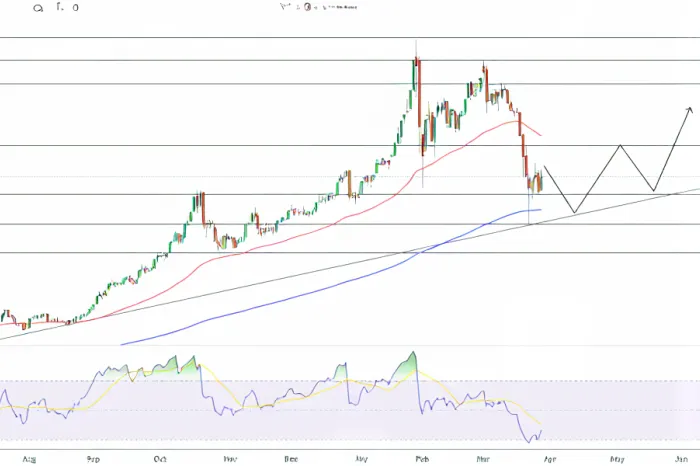
Gold prices have faced sustained downward pressure recently, largely influenced by the strengthening US dollar and growing anticipation of further interest rate increases from the Federal Reserve. In recent trading sessions, gold has fallen to its lowest level in three months, hovering around a critical support zone near $4,110 per ounce. This persistent bearish momentum is supported by both technical analysis and prevailing market sentiment, presenting difficult conditions for gold traders in the near future.
Analysts emphasize that the Federal Reserve’s firm stance on tightening monetary policy remains a primary driver behind gold’s decline. Leading financial institutions such as Deutsche Bank and Bank of America’s Global Research teams have adjusted their forecasts, now expecting an interest rate hike in September followed by additional increases next year. Supporting this outlook, data from the London Stock Exchange indicates a 90% likelihood of a rate increase in the upcoming Federal Open Market Committee meeting, adding pressure on gold prices.
From a technical perspective, key indicators underscore the ongoing downtrend. The Relative Strength Index (RSI) is approaching oversold territory near 30, currently at 33, signaling weakening momentum. Meanwhile, the Moving Average Convergence Divergence (MACD) continues to emit negative signals, and gold prices remain below significant moving averages. These technical factors collectively suggest that sellers maintain control, and a decisive break below the $4,100 support level could trigger further declines.
However, there remains potential for a bullish reversal if buyers manage to push prices above resistance levels at $4,190, $4,275, and eventually $4,330 per ounce. Such gains could indicate a temporary halt or reversal of the current downtrend. Traders are advised to watch these resistance points carefully and apply rigorous risk management strategies given the uncertain market environment.
This challenging landscape reflects the complex dynamics between macroeconomic policies—especially US interest rates—and currency strength influencing gold’s price movements. For those engaged in forex trading involving gold as a commodity, balancing technical signals with evolving economic factors is crucial for navigating volatility over medium- to long-term horizons.
In conclusion, gold remains locked in a bearish trend driven by expectations of tighter US monetary policy alongside a robust US dollar. The support near $4,100 per ounce is pivotal in determining whether selling pressure will intensify or if buyers can regain footing to push prices higher. Market participants should stay cautious and employ disciplined capital management while monitoring global economic indicators that impact both forex trading and commodity pricing.