The AUD/USD currency pair has experienced a notable decline, slipping below the critical 0.7000 level and reaching an eleven-week low. This downward movement reflects growing divergence in monetary policy expectations between the Reserve Bank of Australia (RBA) and the U.S. Federal Reserve, alongside cautious market sentiment ahead of key Australian economic data releases.
The Reserve Bank of Australia recently paused its tightening cycle, holding the cash rate steady at 4.35% after three consecutive hikes earlier this year. RBA Governor Michele Bullock indicated a more cautious stance, suggesting that any future rate increases would be conditional rather than certain. This approach has tempered expectations for near-term rate hikes in Australia.
In contrast, the U.S. Federal Reserve has adopted a hawkish tone under new Chair Kevin Warsh. The Federal Open Market Committee removed previous easing language and signaled the possibility of at least one additional rate hike before the end of the year. This shift has strengthened the U.S. dollar by supporting higher Treasury yields, drawing capital away from the Australian dollar.
Compounding pressure on AUD/USD is the recent easing of geopolitical tensions in the Middle East, which has pushed global energy prices lower. Since Australia’s currency is closely tied to commodity prices, especially energy and raw materials, this decline has weakened one of its key support pillars. Furthermore, softer commodity prices reduce domestic inflationary pressures, reinforcing the RBA’s decision to maintain its current interest rate.
Technical indicators also highlight bearish momentum for AUD/USD. The pair has breached significant support levels around 0.7000, triggering stop-loss orders and accelerating selling pressure. Momentum oscillators such as MACD point to ongoing sell signals, while RSI levels suggest the currency is approaching oversold territory.
Market participants are now closely watching upcoming Australian inflation and employment reports due later this week. Economists expect May’s consumer price index (CPI) to show a slight rise in inflation, which could influence RBA’s future policy moves. Similarly, employment data is anticipated to reflect a modest recovery following a recent drop in jobs and a rise in unemployment.
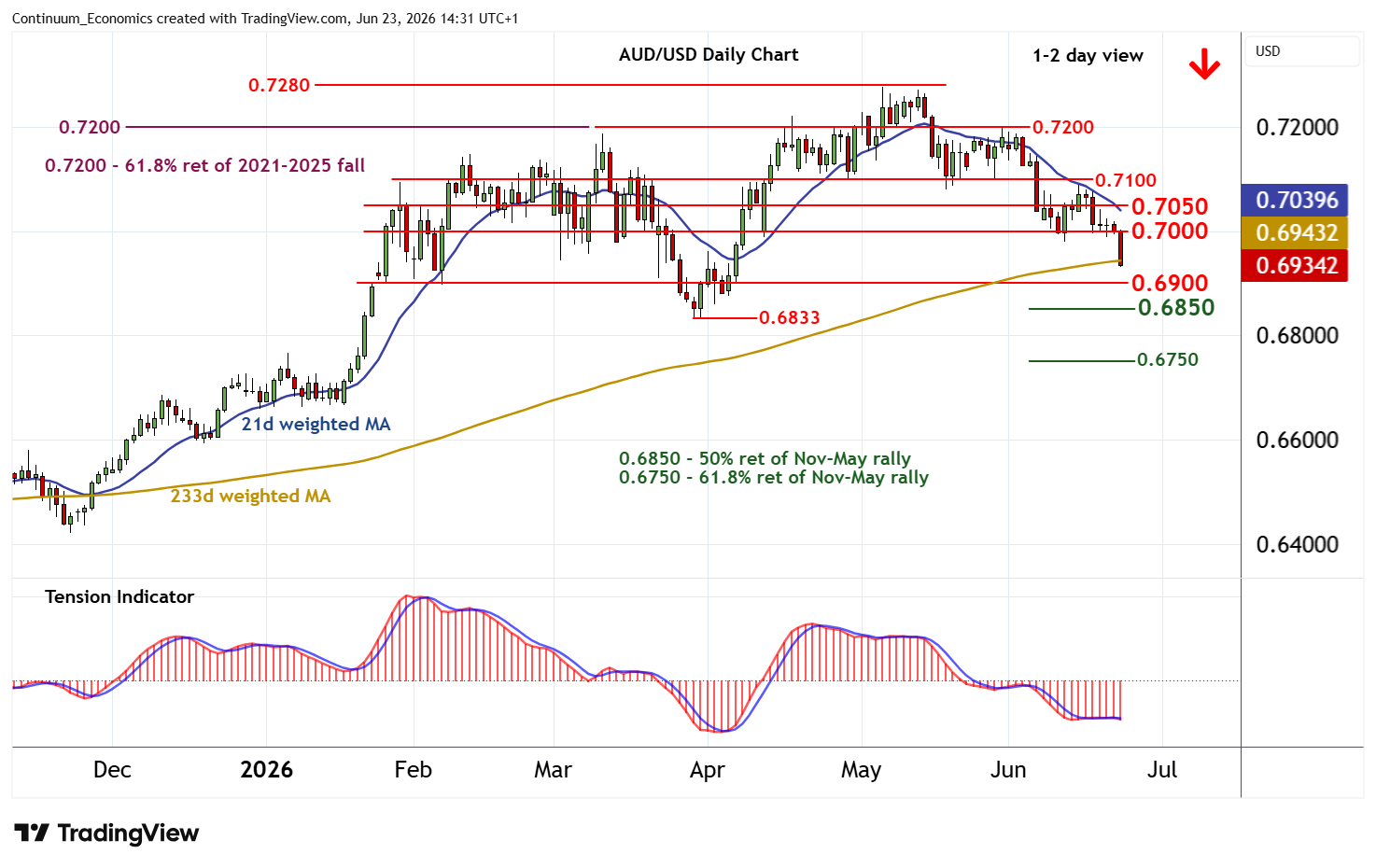
From a technical perspective, failure to reclaim resistance near 0.7080–0.7100 keeps AUD/USD within a bearish trend channel. Should the pair continue its descent, it may test stronger support levels around 0.6900 and potentially down to 0.6835—the March monthly low—if negative momentum persists.
Investors remain cautious amid geopolitical uncertainties and shifting central bank outlooks, with market positioning indicating increased short exposure on the Australian dollar. While commodity price stabilization and potential Chinese stimulus efforts offer some support, the overall outlook for AUD/USD remains tilted to the downside in the near term.
Traders are advised to monitor technical levels closely and consider risk management strategies given the volatile environment surrounding key economic data releases and ongoing global developments.