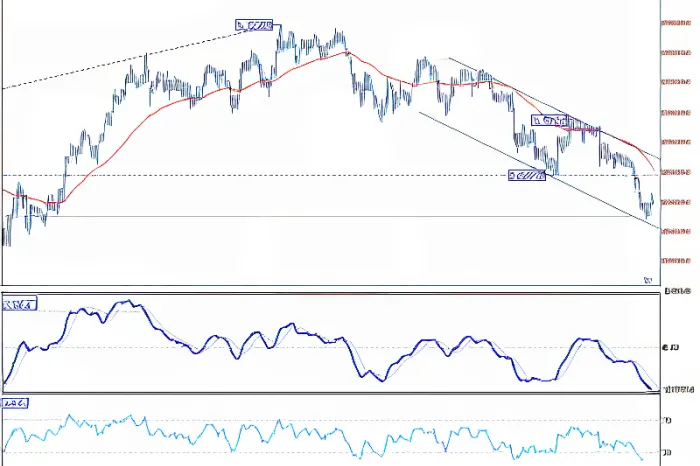
The AUD/USD currency pair has encountered notable downward momentum recently, largely influenced by a robust US dollar and mixed economic indicators emerging from Australia. In recent trading sessions, the pair slipped to an 11-week low, falling just below the critical 200-day exponential moving average (EMA), signaling sustained bearish sentiment among traders.
Technical analysis reveals that AUD/USD is currently testing important support near the 0.6900 level. Traders have identified several congestion zones between 0.6900 and 0.7050, which serve as short-term resistance barriers. Market participants are closely watching these levels for clues on whether the pair will continue to decline or find some stability. Should the pair break decisively below 0.6900, it could open the door to stronger support around 0.6833—the monthly low recorded at the end of March—as well as the Fibonacci retracement level near 0.6850.
Despite the prevailing downtrend, daily stochastic indicators point to oversold conditions, suggesting a possibility for short-term relief rallies or consolidation before any further declines materialize. On the upside, a recovery above the resistance cluster at 0.7000 could reduce selling pressure and encourage sideways trading near the 0.7050 resistance zone.
This price movement unfolds amid ongoing US dollar strength, which continues to exert pressure on commodity-linked currencies like the Australian dollar. The greenback’s gains are supported by favorable interest rate differentials and consistent economic resilience in the United States. Similar weakening trends have been observed in other currency pairs such as NZD/USD and USD/JPY. The New Zealand dollar, in particular, has faced additional losses due to its central bank adopting a more dovish stance compared to Australia’s.
Market participants remain cautious amid these dynamics, emphasizing the importance of monitoring key technical levels alongside upcoming fundamental data releases. Recent Australian consumer price index (CPI) reports have shown mixed outcomes, adding complexity and uncertainty to AUD/USD’s short-term prospects. Analysts recommend paying close attention to support around 0.6840 and resistance near 0.6950 to better anticipate future price direction.
Overall, forecasts indicate continued downside risk for AUD/USD unless significant positive developments emerge to counterbalance the US dollar’s strength. Investors are advised to conduct comprehensive research and apply careful risk management strategies when trading this volatile currency pair.