The Australian dollar (AUD) has experienced downward pressure against the US dollar (USD) despite strong employment figures and resilient consumer spending in Australia. Recent data revealed a drop in the unemployment rate to 4.4%, improving from a five-year high of 4.5%, while employment rose by 40,300 jobs, exceeding expectations. Household spending also saw an unexpected increase of 1.3% in May, well above forecasts of 0.5%. These indicators suggest a robust labor market and steady consumer activity, which typically support the Australian currency.
However, this positive outlook is tempered by underlying inflation concerns and a complex monetary policy environment. The Reserve Bank of Australia (RBA) has maintained its cash rate at 4.35% after three consecutive hikes earlier in the year. Despite the headline consumer price index (CPI) easing to 4.0% year-on-year in May, the trimmed mean inflation—a key gauge of core inflation—rose to 3.6%, signaling persistent price pressures. This divergence complicates the RBA’s path forward, as it balances its dual mandate of controlling inflation within a 2-3% target range while supporting full employment.
Labor market dynamics present a mixed picture. Although headline employment numbers are strong, total hours worked declined by 1.1%, attributed to Australians taking accumulated leave. Moreover, despite record migration levels, significant labor shortages remain across various sectors including healthcare, manufacturing, and mining, with job vacancies still well above pre-pandemic levels. These shortages contribute to sustained wage pressures that may hinder efforts to reduce inflation.
The resilience of household spending amid rising borrowing costs also poses challenges for monetary policy. Since January 2026, the RBA’s rate increases have raised average monthly mortgage repayments substantially, yet consumer spending has not weakened materially. This suggests that household finances remain relatively robust, delaying any potential slowdown in economic activity that might ease inflationary pressures.
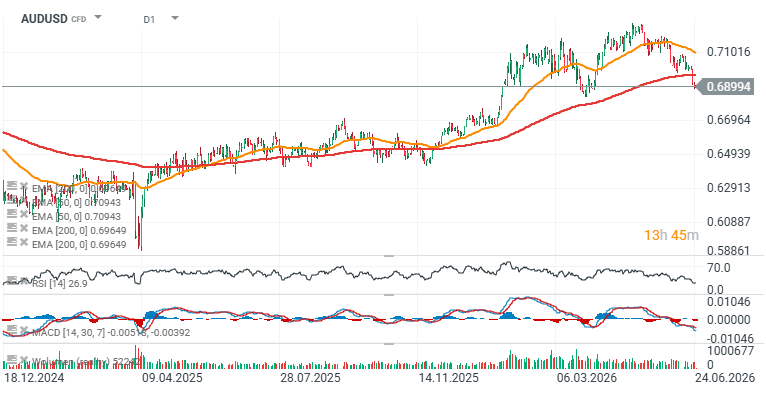
From a currency perspective, AUD/USD has declined below its 200-period exponential moving average (EMA), a level that previously served as support for rebounds since April 2025. The pair hovers near three-month lows around 0.69 to 0.70, with key resistance at the EMA near 0.70 and support around 0.67 from earlier lows in March. While stronger Australian economic data supports the case for higher interest rates and could bolster the AUD, global factors such as risk sentiment and commodity prices continue to heavily influence the currency’s direction.
Looking ahead, upcoming inflation and labor market reports will be crucial in shaping expectations for RBA policy decisions at its August meeting. Money markets currently assign about an 80% probability that the RBA will hold rates steady, but persistent core inflation and resilient employment figures keep the door open for another rate hike. Meanwhile, USD strength ahead of important US economic releases like personal consumption expenditure (PCE) data adds further pressure on AUD/USD.
In summary, while Australia’s labor market shows surprising strength and consumer spending remains firm, underlying inflationary pressures and global uncertainties create a challenging environment for both policymakers and investors. The AUD/USD pair is likely to remain sensitive to these mixed signals as market participants weigh domestic economic resilience against external risks.