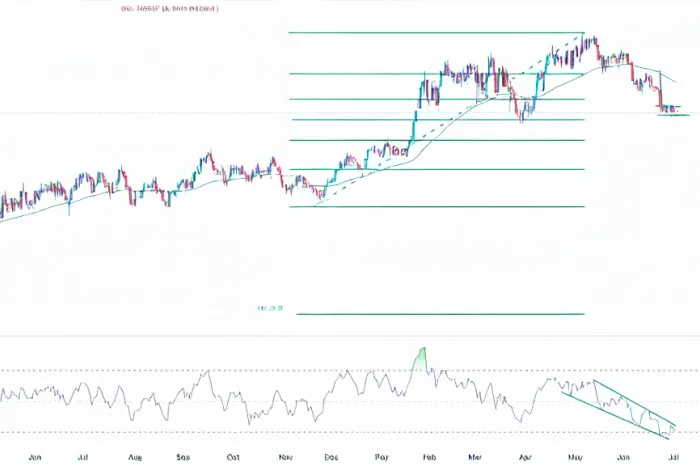
The Australian Dollar has weakened against the US Dollar, with the AUD/USD currency pair falling below the crucial 0.7000 threshold. This decline comes after a period of strength earlier in the year, as traders grow increasingly cautious ahead of key economic data releases. The current bearish momentum suggests near-term challenges for the Australian Dollar.
Market experts from MUFG highlight that the Reserve Bank of Australia (RBA) appears to have concluded its rate-hiking cycle. The central bank’s decision to maintain interest rates at 4.35% reflects mounting concerns over slowing domestic economic growth, subdued consumer spending, and rising unemployment levels. These domestic headwinds are expected to dampen the Australian Dollar’s prospects in the coming months.
Technical indicators reinforce this negative outlook. The AUD/USD pair has dropped below its 200-day Exponential Moving Average and slipped beneath the Ichimoku cloud, both signals pointing to increased selling pressure. A bearish flag pattern is also forming, and the pair is nearing a critical support zone around 0.6828. A break below this support could trigger further declines toward 0.6750, intensifying downward momentum.
Market participants are closely monitoring upcoming US non-farm payroll (NFP) data, which holds significant sway over the pair’s direction. Stronger-than-anticipated US employment figures would likely strengthen the US Dollar and push AUD/USD lower, while weaker job data might ease some pressure on the Australian Dollar. Recent months have seen robust US labor market performance, raising expectations that Federal Reserve policy may remain firm for longer.
Beyond central bank actions, several fundamental factors influence AUD/USD movements. Australia’s economy is heavily tied to commodity prices, especially iron ore, its largest export product. Fluctuations in iron ore prices often lead to corresponding shifts in the Australian Dollar due to changes in trade balances and demand from China, Australia’s primary trading partner. Additionally, easing geopolitical tensions and reduced energy costs have shifted investor focus back toward interest rate differentials between Australia and other major economies.
Despite these mixed signals, technical resistance near the 100-day Simple Moving Average around 0.7100 continues to restrict any sustained rallies in AUD/USD. Immediate support levels are found at the psychological 0.7000 mark and further down near the 200-day SMA at approximately 0.6930.
In conclusion, the outlook for the Australian Dollar remains cautious as both domestic economic challenges and technical indicators suggest further downside risks below 0.7000. Nonetheless, improving global risk sentiment and potential weakening of the US Dollar later in the year could provide some recovery opportunities for AUD/USD. Traders should remain vigilant of upcoming economic reports and key technical levels to better assess future price movements.