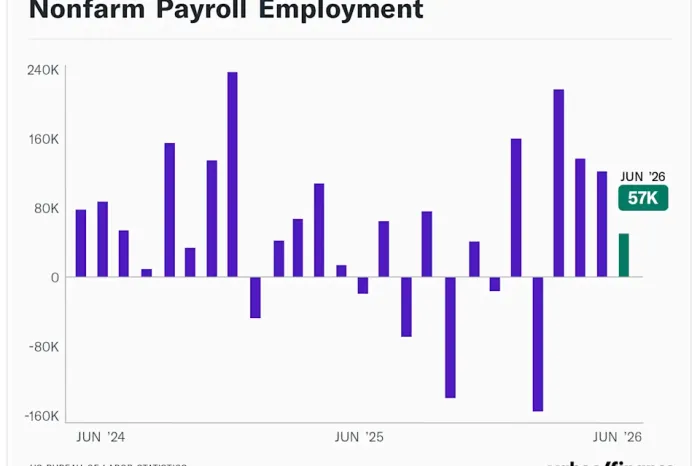
The Federal Reserve’s prospects for raising interest rates later this year have diminished sharply following a weaker-than-expected jobs report for June. According to the Labor Department, the U.S. economy added only 57,000 jobs last month, falling well short of the anticipated 114,000. This significant slowdown in employment growth has led investors and market analysts to rethink the likelihood of further Fed rate hikes.
Gold prices responded strongly to the disappointing data, surging over 2.5% to approximately $4,134 per ounce, bouncing back from an eight-month low. Silver also posted notable gains, climbing around 4.6% to $61.77 per ounce. These precious metals tend to benefit when expectations for higher interest rates fade because they do not yield interest and become more appealing as borrowing costs stabilize or decline.
The report also showed a decline in labor force participation by 0.3 percentage points, dropping to 61.5%, indicating fewer Americans are actively looking for work. Although the unemployment rate edged down slightly to 4.2%, this improvement was partly due to a shrinking labor force rather than a surge in hiring. Particularly striking was the loss of 61,000 jobs in the leisure and hospitality sector during June, contradicting forecasts that expected seasonal hiring boosts linked to events like the World Cup.
Following these revelations, market expectations for a Fed rate increase in July plummeted. The probability of a hike this month fell below 20%, though traders still consider September or October as potential windows for future increases, albeit with lower confidence. Federal Reserve Chair Kevin Warsh reaffirmed the Fed’s commitment to controlling inflation but acknowledged that inflation expectations have softened somewhat recently.
Economists emphasize that while the cooler jobs data challenge the recent narrative of a robust labor market, inflation remains a central concern for policymakers. The Fed is likely to maintain its current pause on rate hikes for now but will continue to monitor inflation trends closely before making any further decisions. San Francisco Fed President Mary Daly described the job market as stable overall and cautioned against drawing conclusions from one monthly report alone.
In addition to weaker employment figures, falling oil prices have helped ease inflationary pressures and supported precious metals by reducing energy cost concerns. Contributing factors include increased oil shipments through strategic routes and progress in indirect U.S.-Iran negotiations.
Overall, these underwhelming employment numbers suggest a cooling labor market that may lessen immediate pressure on the Federal Reserve to tighten monetary policy aggressively. However, with inflation still posing a significant challenge, any future interest rate hikes will depend heavily on upcoming economic data and inflation indicators.