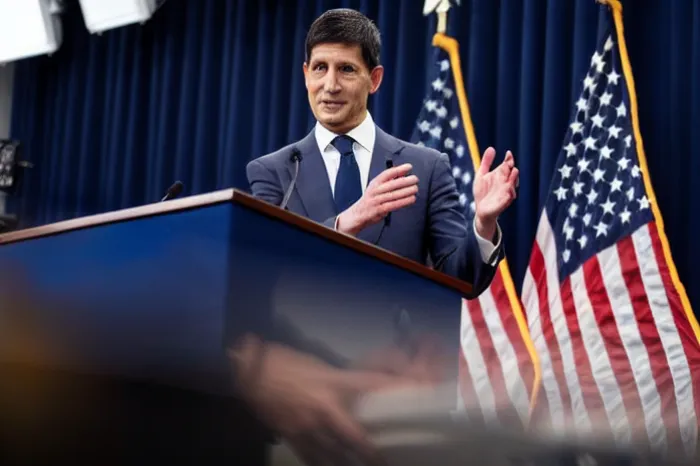
Since President Donald Trump’s return to office, the Federal Reserve has been under unprecedented scrutiny from the White House. Trump has publicly criticized the Fed’s policy decisions and its leadership, even threatening to remove key figures such as former Chairman Jerome Powell and Governor Lisa Cook. This escalating tension has intensified with the recent appointment of Jeremy Warsh as the Fed’s new chairman, who now confronts the challenge of steering the central bank through a politically charged atmosphere while safeguarding its independence.
During a recent CNBC interview, Trump described the Federal Reserve’s board as “hostile” and accused it of “doing the wrong thing.” Despite his praise for Warsh as a “great guy and a great pro,” his comments hinted at significant resistance within the Federal Open Market Committee (FOMC). In response, Warsh stressed that he has not made any promises to the president or political actors regarding monetary policy. At his inaugural press conference in June, he emphasized a unanimous committee stance, aiming to reassure financial markets about the Fed’s cohesion and clear policy direction.
The current climate is further complicated by a Supreme Court ruling favoring Governor Lisa Cook after Trump attempted to remove her without due process. Warsh acknowledged the importance of respecting judicial rulings and expressed confidence in the constitutional framework underpinning the U.S. economy. Although this legal setback did not deter Trump from vowing continued efforts to challenge Cook’s position, it underscored ongoing friction between the White House and the Federal Reserve.
Warsh also highlighted the necessity of adhering to the Fed’s congressional mandate, which focuses on promoting maximum employment, maintaining stable prices, and ensuring moderate long-term interest rates. This approach contrasts with Trump’s view that low interest rates should primarily be used to fuel economic growth. The chairman clarified that the Fed’s role is not to prioritize growth at any cost but to manage economic conditions within its dual mandate responsibly.
Looking back, political interference in Federal Reserve decisions has often led to adverse outcomes. The 1970s tenure of Arthur Burns is frequently cited as a cautionary tale when inflation surged partly due to political pressure from President Richard Nixon. Determined to avoid repeating such mistakes, Warsh appears committed to reinforcing the Fed’s autonomy despite mounting external pressures.
The new chairman faces a complex balancing act: restoring confidence in the Fed’s independence while managing expectations from policymakers and markets amid ongoing political tensions. The recent Supreme Court decision and persistent disputes highlight that politics will remain intertwined with central bank affairs. Nonetheless, Warsh’s dedication to upholding the rule of law and delivering balanced monetary policy aims to guide the Federal Reserve through these turbulent times with stability and credibility.