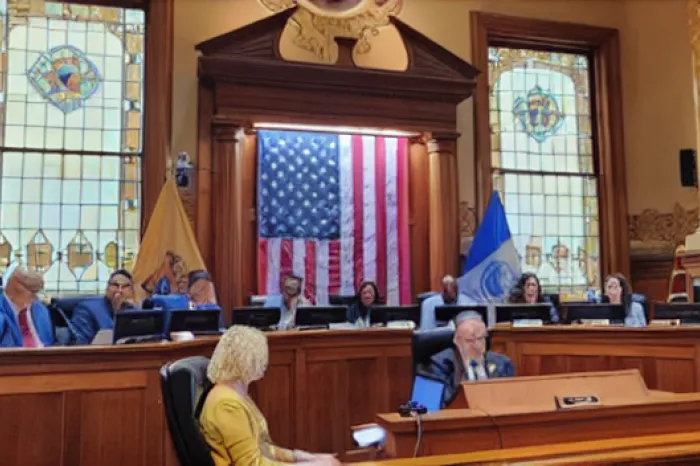
The Jersey City Council has given preliminary approval to a 30-year payment in lieu of taxes (PILOT) agreement for the Canal Crossing development, along with a related measure that directs 10 percent of PILOT revenues to the local Board of Education (BOE). The decision was made during the council meeting on June 10, 2026, where members discussed the benefits and concerns surrounding the project.
The Canal Crossing project involves building a 508-unit residential complex at 850-870 and 874-902 Garfield Avenue, including 102 affordable housing units. The affordable units will be priced at $774 for studios, $829 for one-bedroom apartments, $995 for two-bedrooms, and $1,149 for three-bedroom homes. Council members expressed support for the project, emphasizing its potential to provide long-term affordable housing options for families in Jersey City.
Councilman Tom Zuppa acknowledged the skepticism some residents have toward PILOT agreements due to past controversies but argued that this particular deal could bring significant benefits. Ward D Councilman Jake Ephros noted that council members received detailed information about the project and found it promising. Ward E Councilwoman Eleana Little highlighted that without the PILOT arrangement, the development would likely not move forward.
Several council members stressed the importance of balancing incentives with community benefits. Councilwoman at-Large Mamta Singh said the city aims to help families establish permanent roots through affordable housing. Councilman at-Large Michael Griffin supported the project as an advocate for affordable housing but wished more than 20 percent of units were affordable. Councilman at-Large Rolando Lavarro praised the inclusion of family-sized affordable units and welcomed the BOE’s share of PILOT revenues.
Despite unanimous initial approval (9-0), public comments reflected concerns about the financial impact of the PILOT deal. Activist Esther Wintner warned that the city might lose significant tax revenue compared to conventional property taxes, estimating a $55 million shortfall over 30 years. She urged limiting PILOT agreements to five years to avoid worsening budget deficits. Other voices called for higher affordability standards and questioned whether this was the best approach.
Hudson County Commissioner Bill O’Dea emphasized recruiting local residents to work on the development and suggested increasing the percentage of PILOT funds allocated to schools. Supporters argued that transforming underused land into mixed-use developments is essential for progress and that affordable housing must be balanced with financial realities.
In a separate but related note, the Clayton Rotary Foundation recently donated funds to Camp Evergreen and Rabun County Board of Education, demonstrating ongoing community support for educational initiatives outside Jersey City.
The Jersey City Council’s decision marks a significant step in addressing both affordable housing needs and school funding challenges through innovative use of PILOT agreements. As negotiations continue, stakeholders remain focused on ensuring that developments serve residents’ long-term interests while maintaining fiscal responsibility.