The EUR/USD currency pair has declined to its lowest level of the year, driven by a stronger U.S. dollar amid expectations of further Federal Reserve interest rate hikes. The U.S. dollar recently reached a 13-month high, supported by safe-haven demand during a sell-off in major technology stocks and hawkish signals from the Fed’s latest policy meeting under Chairman Kevin Walsh.
Market participants are now pricing in a 36% chance of a 25-basis-point rate increase at the Federal Reserve’s July meeting, a significant rise from just 8.5% a week earlier. Additionally, the likelihood of a rate hike in September has climbed to approximately 70%, up from 30%. These expectations are bolstered by a resilient U.S. labor market and persistent inflation pressures. Investors are closely watching upcoming U.S. Core Personal Consumption Expenditures (PCE) data for further insights into the Fed’s potential moves.
In contrast, the eurozone faces challenges despite the European Central Bank (ECB) raising rates in June and considering another increase. Investors remain concerned about sluggish economic growth rather than the impact of higher interest rates. Recent data showed that eurozone Purchasing Managers’ Indexes (PMIs) contracted again in June, indicating continued weakness in services and overall economic stagnation rather than recovery.
ECB President Christine Lagarde recently adopted a somewhat dovish tone, downplaying fears of second-round inflation effects and stating that inflation expectations remain anchored despite inflation levels above 3%. Her remarks suggest limited scope for aggressive ECB rate hikes beyond neutral levels, which restricts the euro’s potential gains against the dollar.
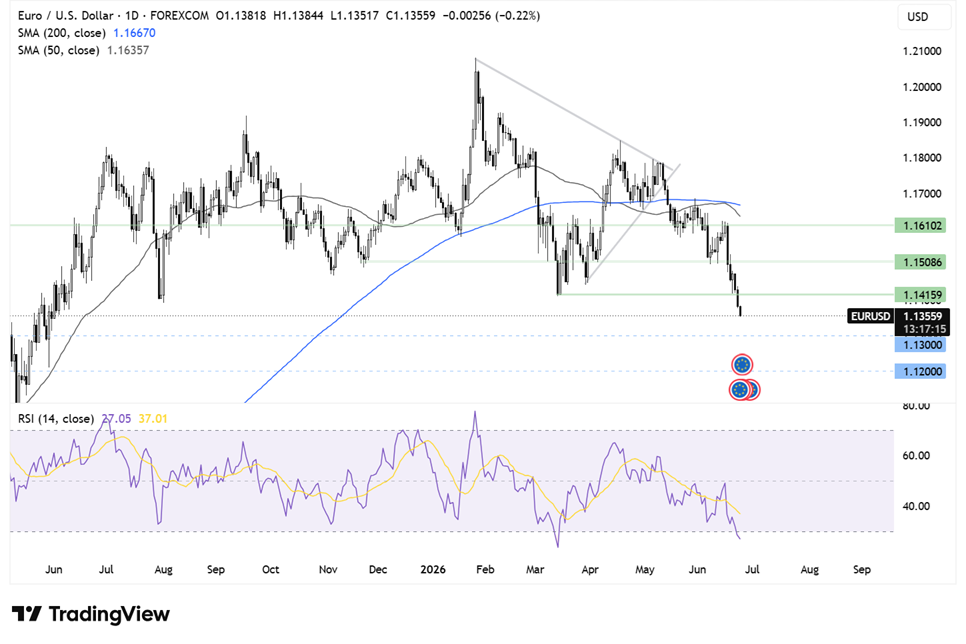
Technically, EUR/USD has broken below key support levels, including its symmetrical triangle pattern and both the 50-day and 200-day simple moving averages (SMA). The pair touched a low near 1.1350, with momentum indicators pointing to continued bearish pressure, although the relative strength index (RSI) nears oversold territory, which may slow the pace of decline. Key levels to watch include support around 1.1300 and 1.1200 on the downside, while resistance lies near 1.1400 and 1.1500.
Meanwhile, oil prices have fallen to four-month lows amid easing supply concerns as vessel traffic through the Strait of Hormuz gradually recovers. Current flows remain below pre-conflict levels but have improved enough to reduce geopolitical risk premiums on crude prices. Saudi Arabia and the UAE’s use of alternative pipelines also supports supply normalization.
U.S. crude inventories recently increased by 765,000 barrels, adding to downward pressure on prices. Technically, oil has dropped below critical support zones including its symmetrical triangle and 200-day SMA, reaching around $72 per barrel. Sellers may target further declines toward $69 and potentially $62 if bearish momentum continues, while any recovery would need to surpass resistance near $74 and then $80.
Overall, EUR/USD faces downward pressure due to divergent monetary policies between the Fed and ECB combined with weak eurozone growth prospects. Oil markets are adjusting to improved supply conditions despite ongoing geopolitical uncertainties. Traders should monitor upcoming U.S. inflation data and Middle East production trends closely for clues on future movements in these key markets.