
 Anna
Anna 
The USD/JPY exchange rate showed signs of stabilization following recent intervention measures by Japanese authorities aimed at halting the prolonged depreciation of the yen. Tokyo’s Ministry of Finance (MoF) and the Bank of Japan (BoJ) implemented a series of intervention checks, which helped temper the sharp slide of the yen against the US dollar, bringing the pair back near the 149.00 level after it had surged past 150.00.
Japan’s approach involved ‘rate checks,’ a tactic where officials communicate directly with market participants to gauge exchange rates and signal potential intervention. This method serves as a warning to traders and speculators, indicating that authorities are monitoring the market closely and may step in if necessary. The recent actions reflect growing concern over the yen reaching a 32-year low amid persistent selling pressure driven by the widening interest rate gap between Japan and the United States.
The Federal Reserve’s continued high interest rates contrast sharply with Japan’s ultra-loose monetary policy, making the yen less attractive for investors seeking higher yields. This dynamic has encouraged carry trades that favor the US dollar, further pressuring the yen. However, Japan’s recent interventions suggest officials are unwilling to allow unchecked depreciation, especially after the USD/JPY crossed critical psychological thresholds that had previously triggered direct market action.
Market response to these interventions was immediate and marked by volatility. The USD/JPY pair initially spiked but quickly reversed course, falling more than 100 pips within hours. Trading volumes increased sharply, reflecting active participation from institutional investors and algorithmic trading systems. Meanwhile, Japanese equities experienced some pullback as a stronger yen threatens export competitiveness.
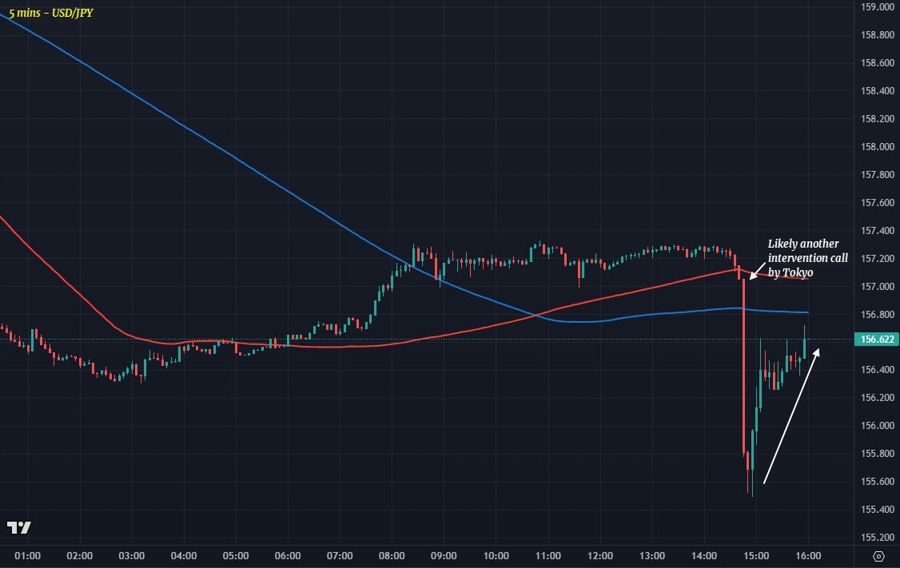
Analysts remain divided on whether these interventions will produce lasting effects. Some experts argue that without a fundamental shift in BoJ’s monetary policy stance, any yen strengthening will be temporary. Others believe these moves may establish a short-term floor for the currency if markets perceive credible commitment from Japanese authorities to defend it. The key level to watch remains around 150.00; surpassing this could prompt more aggressive intervention.
Japan’s historical experience with currency interventions provides context for current developments. Previous direct actions in 2022 involved substantial expenditure—over $20 billion in one instance—to support the yen when it reached critical lows. Although current declines have been more gradual, allowing for measured responses, past interventions have only temporarily paused yen weakness before trends resumed.
The broader implications of yen stabilization extend beyond Japan’s borders. A stronger yen helps reduce import costs, particularly for energy and food, which can ease inflationary pressures domestically. It also lowers risks of competitive currency devaluations in Asia, where regional currencies often move in tandem with the yen. For global investors and multinational corporations exposed to Japanese markets, a steadier USD/JPY exchange rate reduces uncertainty and allows for more effective hedging strategies.
Looking ahead, market participants will closely monitor upcoming events such as BoJ policy meetings and US inflation data releases that could influence monetary policy directions and currency valuations. The delicate balance between intervention efforts and underlying economic fundamentals is likely to keep USD/JPY exchange rate movements volatile in the near term.
