The Australian dollar (AUD/USD) is experiencing downward pressure following the release of weaker-than-expected jobs data, which has led traders to reconsider the Reserve Bank of Australia’s (RBA) future interest rate moves. The unemployment rate in Australia rose to 4.5% in April, surpassing the RBA’s forecast of 4.2%, while employment fell by 18,600. This unexpected deterioration in the labor market has raised doubts about further rate hikes, prompting a shift in market expectations.
The RBA had previously indicated that its recent rate increase would create room to assess economic conditions before making additional decisions. However, the higher unemployment rate and slipping participation rate suggest that the labor market may not be as tight as previously assumed. Despite this, those employed are working longer hours, with hours worked per employee increasing by 0.9%, and the underemployment rate slightly decreasing to 5.8%, indicating firms may be reducing headcount but relying more on existing workers.
As a result of these developments, bond futures have reacted strongly, breaking above key resistance levels, signaling that investors are pricing in a pause in rate hikes. Market expectations for a 25 basis point increase at the June RBA meeting have dropped significantly from around 22% to just 6%. This has also influenced Australian three-year bond futures, which have shown signs of reversing previous downward trends.
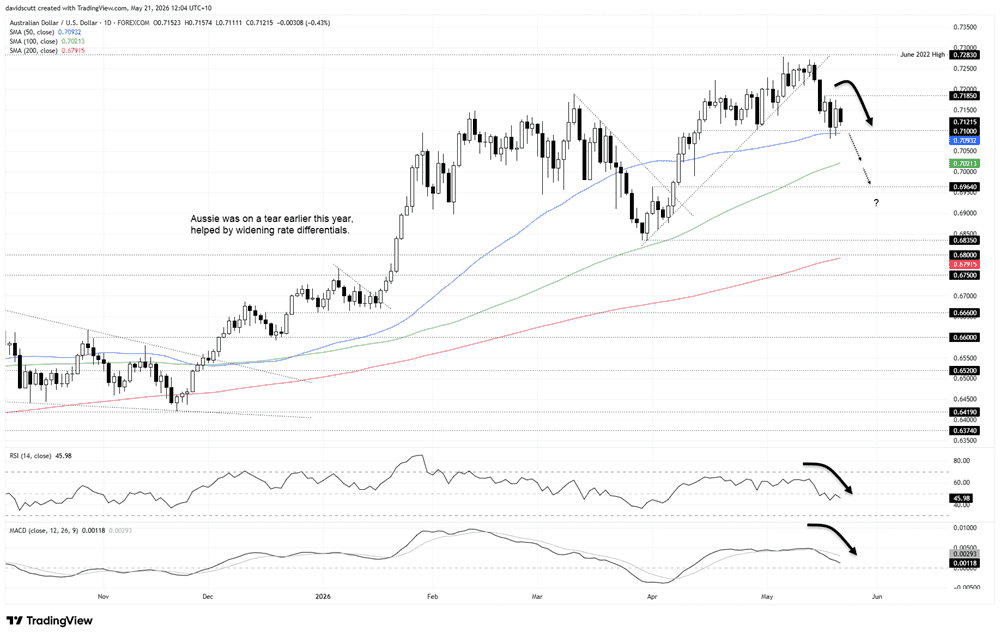
The AUD/USD currency pair has declined sharply against major currencies following the jobs report, approaching a critical support zone near the 50-day moving average and the .7100 level. Technical indicators suggest early signs of weakening momentum, raising concerns about potential further declines toward the 100-day moving average near .7000 and possibly lower to .6964 if support fails. On the upside, resistance near .7185 remains a key level to watch for any recovery attempts.
Meanwhile, risk appetite continues to play a dominant role in driving AUD/USD movements. The currency’s rebound from lows around the mid-60 cent range last year was largely influenced by interest rate differentials. Thus, the recent soft labor market data could have lasting implications if upcoming inflation figures do not support continued hawkish central bank policies or if further employment weakness emerges in subsequent reports.
In equity markets, Australia’s ASX 200 index appears to be finding a base after recent declines. The index has seen strong buying interest at levels below 8500, with momentum indicators such as RSI and MACD hinting at a possible reversal. A break above 8650 could open the door for gains toward longer-term moving averages and downtrend resistance levels, supported by improving risk sentiment across Asia and potential tailwinds from stable interest rates.
Globally, central bank policies remain influential on currency markets. Recent Federal Open Market Committee (FOMC) minutes from the United States have shown a hawkish stance, contributing to fluctuations in AUD/USD as traders weigh divergent monetary policy paths between major economies. This dynamic adds complexity to forecasting movements in AUD/USD amid evolving economic data and geopolitical factors.
Overall, the combination of softer Australian employment figures and shifting central bank signals is creating uncertainty around the Australian dollar’s near-term trajectory. Market participants are closely monitoring upcoming economic releases and central bank communications for clearer guidance on policy direction and its impact on AUD/USD.