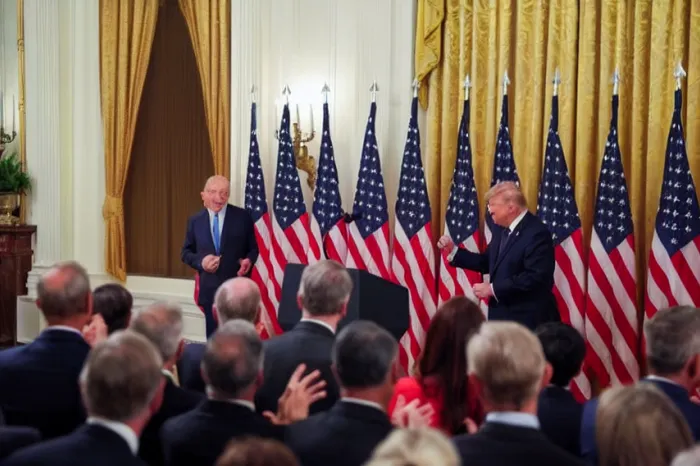
Kevin Warsh was officially sworn in as the 17th chair of the Federal Reserve in a ceremony held at the White House, stepping into a pivotal role during a period of significant economic uncertainty. The event was attended by Supreme Court Justice Clarence Thomas and other senior officials, underscoring the critical nature of maintaining the Fed’s independence amidst mounting political pressures. President Donald Trump publicly urged Warsh to exercise independent judgment, emphasizing that decisions should be free from external influence.
Warsh assumes leadership at a time when inflation is hovering near a three-year peak, driven in part by surging energy prices linked to ongoing geopolitical conflicts in the Middle East. The Federal Reserve has struggled to reduce inflation to its long-standing 2% target for over five years, with recent developments complicating efforts. Despite President Trump’s calls for interest rate cuts to bolster economic growth ahead of upcoming elections, Warsh faces a divided Federal Open Market Committee (FOMC). Most members currently support maintaining current rates or even raising them if inflation remains persistent.
As Fed chair, Warsh has committed to steering a reform-minded central bank that learns from both past achievements and shortcomings. His stated priorities include preserving price stability and fostering maximum employment. However, experts highlight that Warsh’s ability to implement rapid policy shifts is constrained by the need to secure consensus among FOMC members. Key decisions regarding interest rates and managing the Fed’s $6.7 trillion balance sheet require majority approval within this committee.
Warsh succeeds Jerome Powell, whose tenure was marked by public clashes with the White House over monetary policy decisions. Unlike Powell, Warsh has received a more conciliatory tone from President Trump, who has expressed a desire for the Fed chair to act independently. Nevertheless, some lawmakers and economists remain cautious about Warsh’s autonomy given his prior ties to both the Trump administration and Wall Street.
The Federal Reserve currently faces a complex dilemma: inflation shows no clear signs of rapid decline, yet raising interest rates further risks slowing economic growth or even triggering a recession. Some officials argue that traditional rate hikes may be ineffective against supply-driven inflation caused by energy shocks and tariffs. Consequently, Warsh is expected to approach policy decisions with caution, balancing efforts to control inflation while supporting economic stability amid internal committee divisions.
Warsh’s term begins amid uncertainty about future monetary policy moves. Market sentiment has shifted toward anticipating a possible rate increase late this year following midterm elections rather than immediate cuts. The new Fed chair must work diligently to build consensus among diverse FOMC members while managing external pressures from the White House and financial markets alike. His leadership will be closely observed as the Federal Reserve navigates persistent inflation challenges alongside ongoing geopolitical risks.