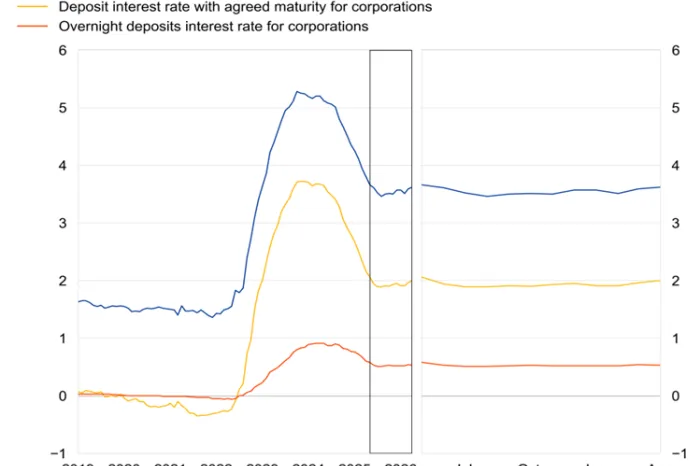
The European Central Bank (ECB) released its latest bank interest rate statistics for April 2026, showing a steady borrowing cost for corporations but an increase in interest rates for household loans, particularly those related to house purchases. The composite cost-of-borrowing indicator for new corporate loans held stable at 3.62%, while the indicator for new household loans for house purchases rose by nine basis points to 3.44%. These figures highlight a cautious lending environment amid ongoing inflationary pressures in the euro area.
Corporate borrowing costs displayed minor fluctuations across different loan types. Large loans exceeding €1 million with short-term floating rates remained steady at 3.31%, whereas similar loans with intermediate fixed-rate periods saw a slight decline to 3.50%. Conversely, long-term loans fixed for over ten years increased marginally to 3.74%. Smaller loans up to €250,000 with short-term floating rates experienced a modest rise in interest rates to 3.70%. Deposit rates from corporations remained largely unchanged, with fixed maturity deposits at 2.00% and overnight deposits stable at 0.53%.
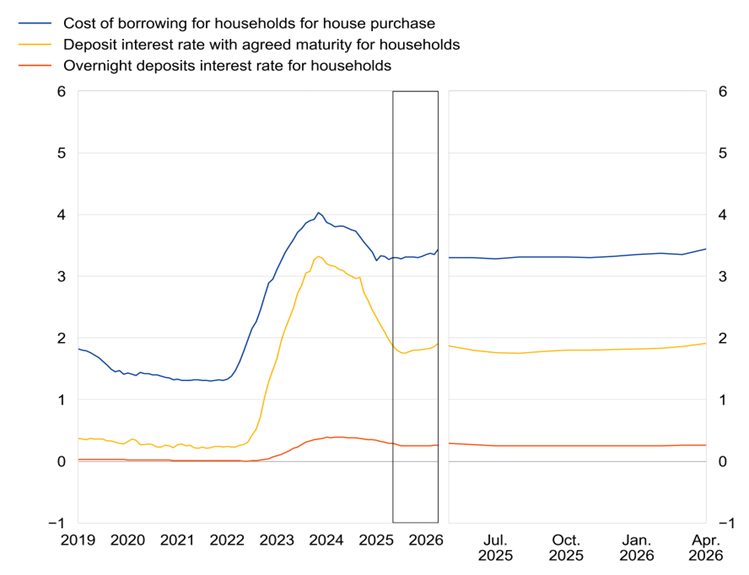
For households, borrowing costs climbed more noticeably. Loans for house purchases with varying fixation periods all recorded increases ranging from six to nine basis points, pushing the overall composite indicator upward. Consumer loans also saw a significant rise of thirteen basis points, reaching an average rate of 7.59%. Deposit rates from households edged up slightly for fixed maturities to 1.91%, while overnight deposit rates remained unchanged at 0.26%.
These interest rate trends coincide with recent ECB analysis highlighting inflation risks in the euro zone. Inflation reached 3.2% in May 2026, surpassing the ECB’s 2% target, partly due to rising energy prices influenced by geopolitical tensions in Iran. Senior ECB economists warned that while some factors suggest lower inflationary risks compared to the spike seen in 2022, other conditions indicate potential for higher inflation pressures this time around.
The current inflation shock differs from the 2022 episode by being more global and affecting broader sectors through complex supply chains. This global nature increases the chance of amplified inflationary effects on import prices and domestic costs. Additionally, households may adapt their expectations faster due to recent experiences with high inflation, and governments have less fiscal space to mitigate price growth.
The ECB’s cautious outlook suggests that while a small rate hike is expected soon, aggressive monetary tightening may not follow immediately due to subdued demand and softer labor markets. However, the evolving situation requires close monitoring as inflation dynamics remain uncertain.
Overall, the April bank interest rate data reflect a delicate balance between maintaining credit availability and addressing inflation concerns across the euro area economy. Borrowers and savers alike are experiencing shifts in loan and deposit rates that mirror broader economic challenges faced by policymakers.