The European Central Bank (ECB) recently increased its key interest rate by 25 basis points to 2.25%, marking its first hike since 2023. This move comes as the eurozone continues to grapple with rising inflation driven largely by higher energy costs linked to the ongoing conflict in the Middle East. Despite a tentative peace agreement between the United States and Iran aimed at reopening the Strait of Hormuz, ECB officials warn that the energy price shock will persist for months, keeping inflation elevated above their 2% target.
Eurozone annual inflation rose to 3.2% in May from 3.0% in April, reflecting the continued impact of geopolitical tensions on energy prices. ECB Governing Council members, including Peter Kazimir and Gabriel Makhlouf, emphasized that while the peace deal offers some hope, it does not immediately reverse the damage caused by the conflict. The sustained high energy prices have led businesses to increase selling prices and workers to demand higher wages, contributing to ongoing inflationary pressures.
Alongside the rate hike, the ECB revised its inflation forecasts upward, projecting a 3.0% average inflation rate for 2026, up from an earlier estimate of 2.6%. Inflation is expected to moderate to 2.3% in 2027, though growth forecasts were downgraded to 0.8% for this year and 1.2% for next year due to these economic challenges. Market analysts anticipate one more rate increase, likely in September, before interest rates stabilize through 2027.
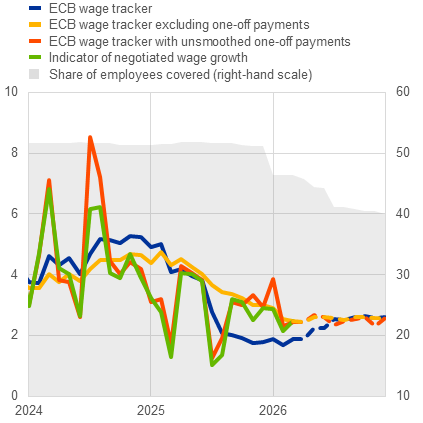
Wage growth remains a critical factor in the ECB’s outlook on inflation. The latest ECB wage tracker data indicates stable negotiated wage increases averaging around 2.6% in 2026. This suggests that wage pressures are contained and that a price-wage spiral—where rising wages lead to higher prices and vice versa—is unlikely at this stage. Compensation per employee is expected to grow by about 3.2% in 2026 and remain steady through 2027 and 2028, aligning with the ECB’s goal of medium-term price stability.
The ECB faces a delicate balancing act between curbing inflation driven by external shocks and avoiding excessive tightening that could slow economic growth further. Forward-looking indicators such as purchasing managers’ indices show that while energy costs are gradually affecting other sectors, their impact remains less severe than during previous crises like in 2022.
In summary, the ECB’s recent policy actions underscore its commitment to maintaining price stability amid ongoing uncertainties related to energy markets and geopolitical tensions. While wage growth remains moderate, the central bank signals readiness for additional tightening if inflation pressures persist. This cautious approach aims to navigate the eurozone through a challenging economic environment without triggering a deeper slowdown.