The EUR/USD currency pair has been under significant pressure recently, influenced by a combination of weak economic data from the Eurozone and sustained strength in the US dollar. On June 23, preliminary figures showed the Eurozone Purchasing Managers Index (PMI) for manufacturing at 49.5, indicating continued contraction in business activity despite a slight improvement from previous months. This reading suggests that while the pace of decline may have slowed, economic growth remains elusive for the region.
Germany, the largest economy in the Eurozone, contributed to this subdued outlook with its own PMI figures. The manufacturing sector held steady at 50.0, signaling no growth compared to the previous month, but the services sector contracted more sharply than expected, with a PMI falling to 46.8. This decline in services activity added further downward pressure on the euro.
Meanwhile, energy costs in the Eurozone have been easing ahead of a recent US-Iran deal aimed at stabilizing geopolitical tensions and lowering oil prices. This reduction in energy input costs is beneficial for the Eurozone economy as it is a net energy importer, potentially improving trade terms. However, softer inflation and weak growth data are giving the European Central Bank (ECB) less incentive to continue aggressive interest rate hikes, which traditionally support the euro’s value against other currencies.
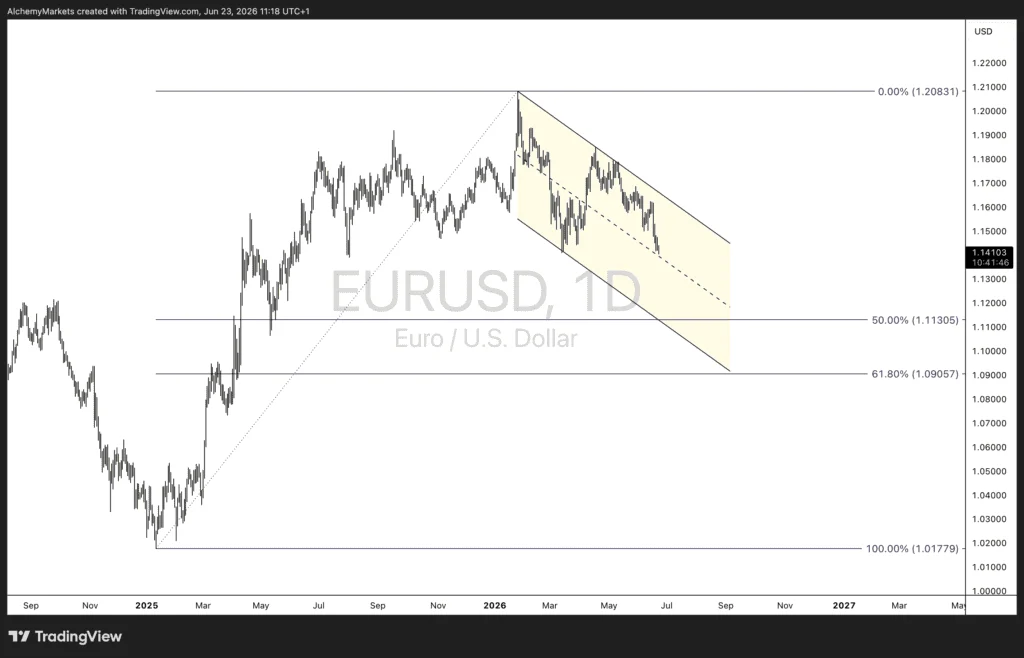
On the technical side, the EUR/USD pair is trading near 1.1408, positioned within a descending channel that has been intact since hitting a high of 1.2083 earlier in the year. The price action suggests sellers remain dominant, pushing the pair closer to a key support zone around 1.1130, where multiple technical indicators converge including Fibonacci retracement levels and historical horizontal support.
The US dollar’s strength is a major factor influencing this downward trend in EUR/USD. Following signals from Federal Reserve officials hinting at potential interest rate hikes later this year and a hawkish tone from new Fed Chair Kevin Warsh, market expectations of higher US rates have bolstered demand for the dollar. The US Dollar Index (DXY) recently surged to levels not seen since early last year, reflecting this robust demand.
Looking ahead, traders are closely watching upcoming PMI releases from both Europe and the US for further cues on economic health and central bank policy directions. While technical analysis points to continued downside risk for EUR/USD toward targets near 1.1350, any softening in US monetary policy stance could provide relief and halt further declines.
In summary, the EUR/USD exchange rate is navigating through a challenging landscape marked by weak Eurozone economic data, easing inflation pressures limiting ECB rate hikes, and persistent US dollar strength driven by hawkish Federal Reserve signals. This combination suggests that unless there is a significant shift in either economic fundamentals or central bank policies, EUR/USD may continue to test lower support levels in the near term.