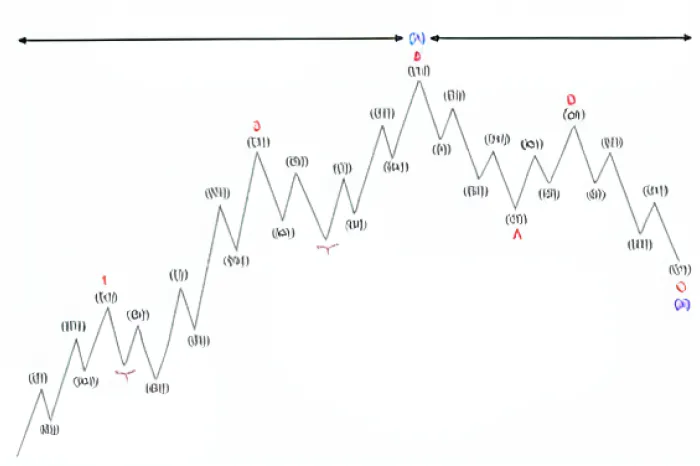
The EUR/USD currency pair has exhibited a textbook example of Elliott Wave theory throughout the first half of 2026. Analysts monitoring this major forex pair identified a distinct five-wave impulse pattern beginning near 1.0178 and advancing to just below 1.2100. This price movement aligns perfectly with the classic Elliott Wave framework, where five waves propel the market in the direction of the dominant trend.
Initial forecasts made in late January pointed to wave 3 as a powerful upward surge, followed by wave 4, which formed a triangular consolidation pattern. This corrective phase, broken down into waves (a)-(b)-(c)-(d)-(e), indicated that the final wave 5 was imminent and expected to drive EUR/USD toward new highs near 1.2100.
As predicted, EUR/USD reached a peak around 1.2083 before losing upward momentum. The pair then entered a corrective phase marked by a three-wave decline, commonly described as an A-B-C retracement in Elliott Wave terms. This pullback brought the currency pair down to approximately 1.1325, representing a notable drop of about 6.3% from its recent five-year high.
This decline was not smooth; it was interrupted by wave B, which temporarily slowed the downward trend before wave C completed the correction. This sequence reinforced the typical Elliott Wave pattern, where a strong five-wave advance is generally followed by a three-wave correction, reflecting normal market dynamics.
Although Elliott Wave analysis can sometimes be complex and subject to alternative readings, the recent movement in EUR/USD has been relatively straightforward. The presence of the wave 4 triangle served as a strong signal that the bullish momentum was tapering off and that a significant corrective phase was underway.
Traders should keep in mind that while technical patterns like these provide valuable insights into potential price directions, they do not guarantee specific outcomes. Integrating Elliott Wave analysis with other technical indicators and fundamental factors remains crucial for making informed trading decisions.
In conclusion, EUR/USD’s recent price action offers a compelling real-world example of Elliott Wave theory in action. The clearly defined wave patterns have helped highlight important support zones and forecast market reversals with impressive accuracy, providing traders with practical guidance amid volatile forex conditions.